
How to Search Cumberland County Court Records
Cumberland County court records are searched through the North Carolina eCourts Portal. The NC Judicial Branch links the Portal from its Cumberland County page as "Portal (Search/Pay)." You can search court information, look up court dates and hearings, view case details, and pay fines and costs on eligible criminal cases and infractions. The Portal is free. Most people do not need an account to view public records.
Before you start, gather the strongest detail you have. A case number or citation number gives an exact match. A party name works too. The Portal also accepts attorney name, attorney bar number, business name, cross-reference number, or a nickname.
The screenshot below comes from the official North Carolina eCourts Portal home screen.
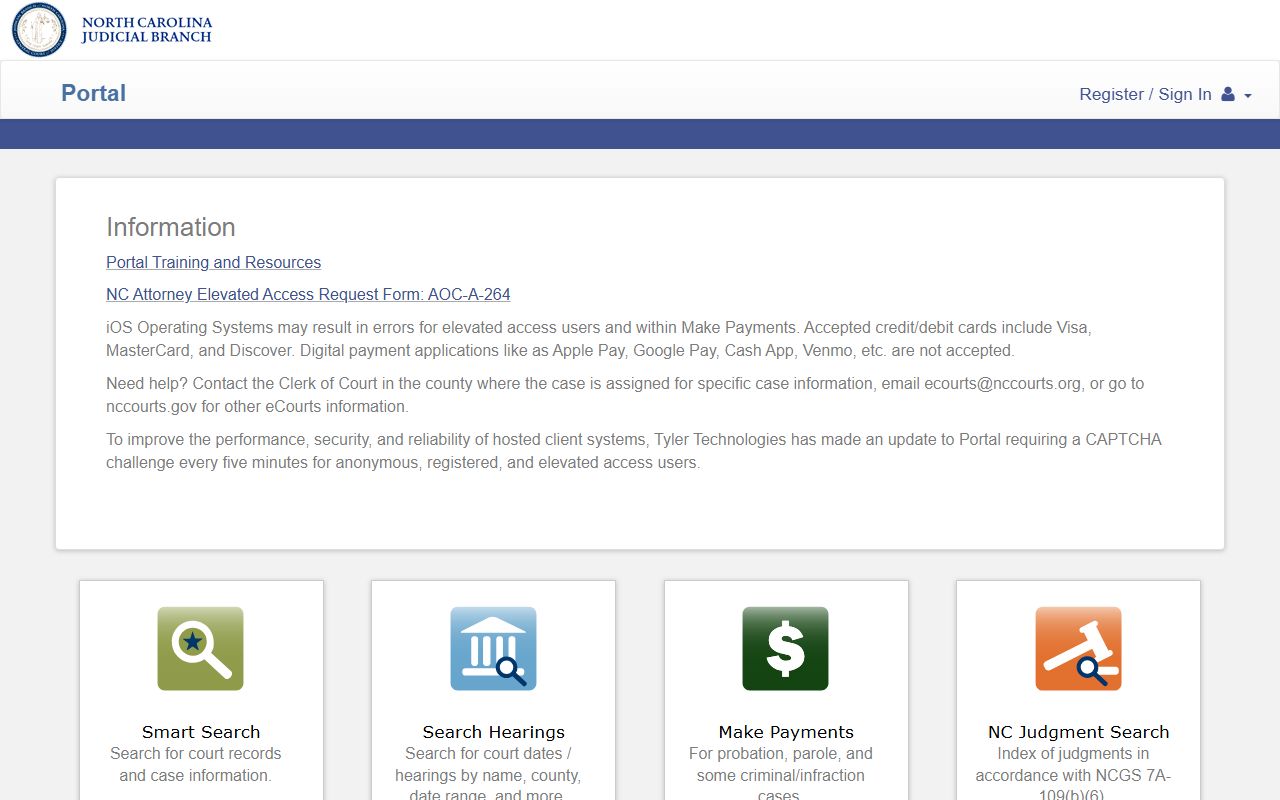
From this screen you pick Smart Search, Search Hearings, or the Judgment Search, then filter to Cumberland County.
- Open the NC eCourts Portal or start from the Cumberland County Judicial Branch page.
- Choose a tool. Use Smart Search for case summaries, Search Hearings for calendars, and Judgment Search for the judgment index.
- Enter your best identifier. A record number or citation number beats a name for an exact match.
- Filter to Cumberland County and pick a case type to narrow the list.
- Open the Case Summary, also called the Register of Actions, to read parties, events, hearings, and dispositions.
- Contact the Clerk of Superior Court for an official or certified copy. The Portal is not the official record.
New users can find guides on the official eCourts Portal training and resources page.
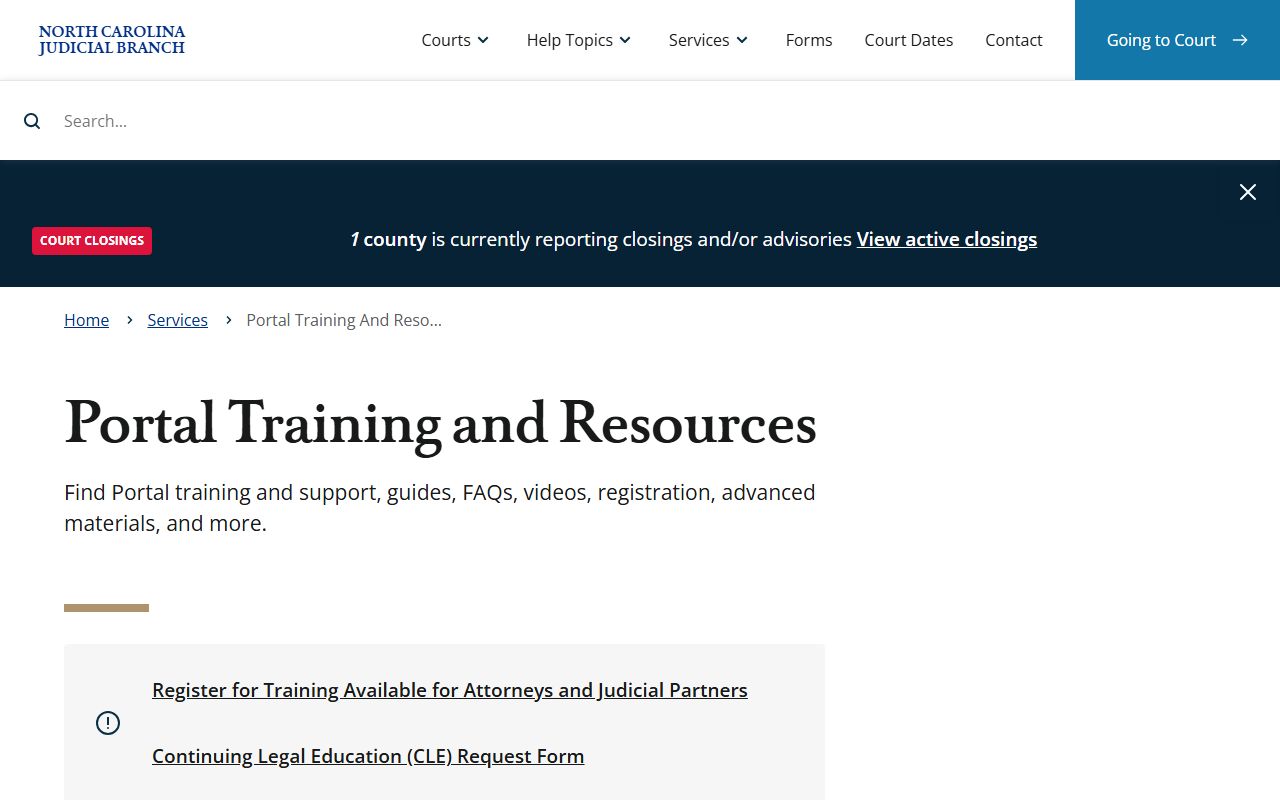
These guides explain Smart Search and how the case summary is laid out.
The Cumberland County Judicial System
North Carolina runs a unified court system under the NC Judicial Branch. Cumberland County is District 14 for prosecutorial, Superior Court, and District Court purposes. There are no county courts at law and no justice-of-the-peace courts here. The trial work splits between two divisions, and appeals move up to the state appellate courts.
Superior Court is the trial court of general jurisdiction. It hears felony criminal cases, civil cases above the District Court limit, and appeals from District Court. District Court handles misdemeanors, infractions, traffic matters, domestic and family cases, juvenile matters, and small claims. Magistrates are District Court officers who take initial appearances, set bail in many cases, and handle small claims and evictions.
Case flow: District Court › Superior Court › North Carolina Court of Appeals › North Carolina Supreme Court
This overview of the Cumberland County court system is published by the state.
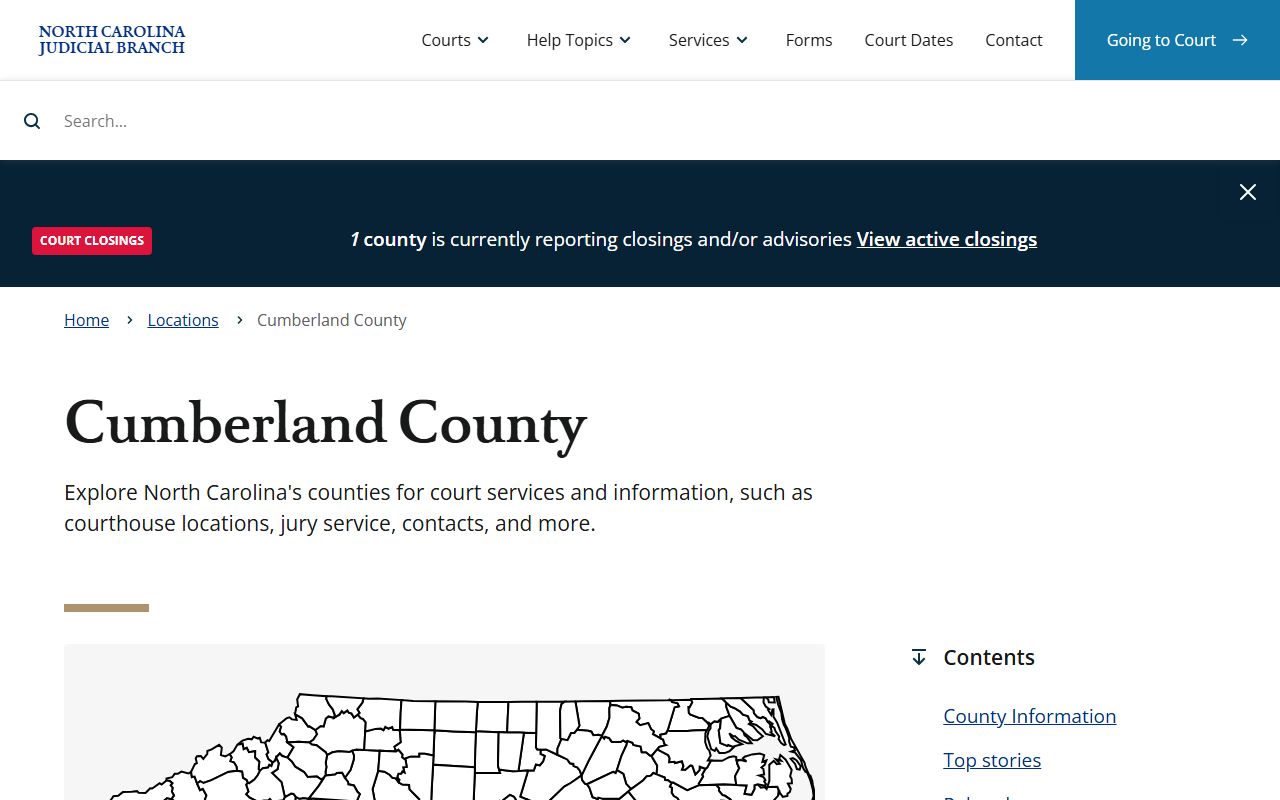
The same page links the contact directory, calendars, payment information, and local forms.
| Court | Jurisdiction | Case Types |
|---|---|---|
| NC Supreme Court | Highest appellate court | Questions of law, final appeals |
| Court of Appeals | Intermediate appellate court | Most appeals from trial courts |
| Superior Court | General jurisdiction trial | Felonies, larger civil cases, District Court appeals |
| District Court | Limited jurisdiction trial | Misdemeanors, traffic, family, juvenile, small claims |
| Magistrates | District Court officers | Initial appearances, small claims, warrants |
Cumberland County Courthouse
Court cases for the county are heard at one main courthouse in downtown Fayetteville. The building holds the Clerk of Superior Court, Superior and District Court functions, the District Attorney, magistrates, family court administration, and the Trial Court Administrator. The Register of Deeds office is in the same complex, in Room 114.
The official courthouse page lists the address, hours, and building facilities.
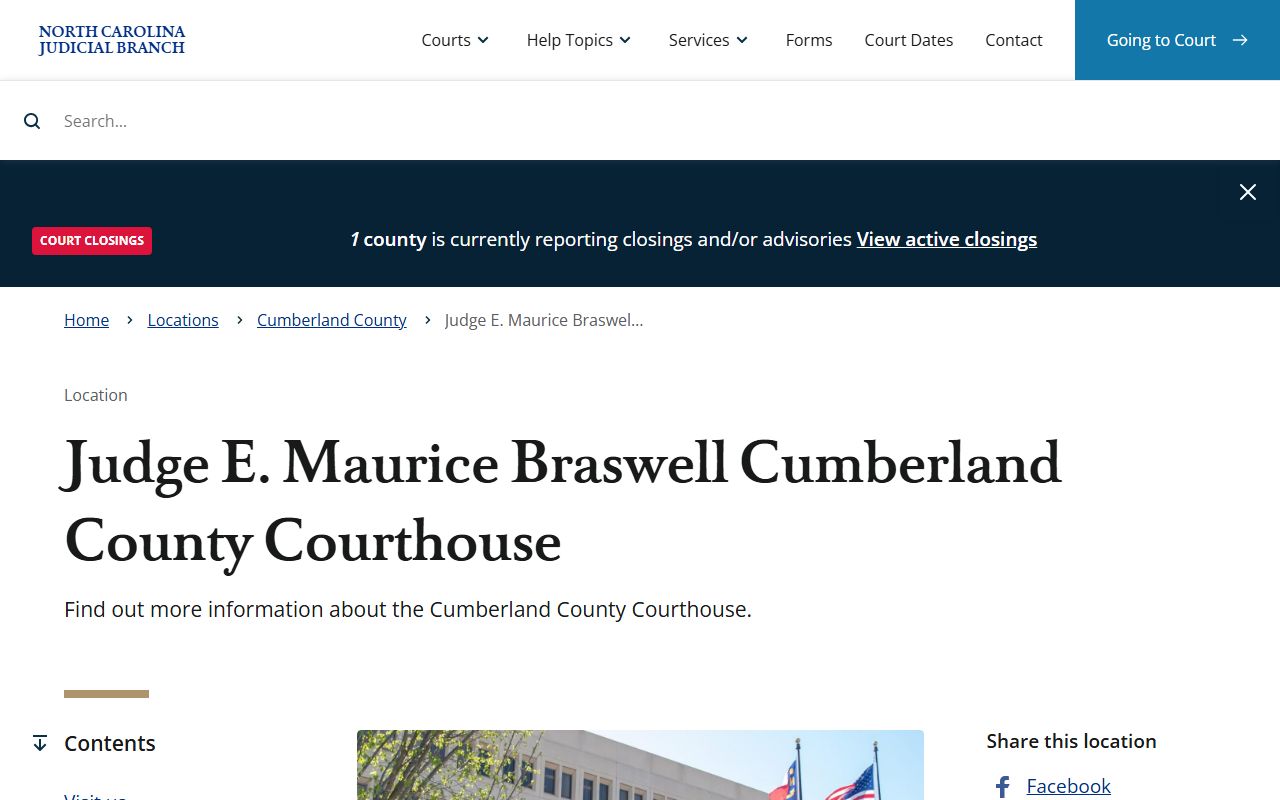
Listed facilities include elevators, wheelchair access, baby changing stations, and a deli.
Judge E. Maurice Braswell Cumberland County Courthouse
117 Dick St.
Fayetteville, NC 28301
(910) 475-3000
Mon-Fri 8:00 AM - 5:00 PM
Clerk of Superior Court
117 Dick St.
Fayetteville, NC 28301
(910) 475-3000
Mailing: PO Box 363, Fayetteville, NC 28302
Cumberland County Sheriff's Office
131 Dick Street
Fayetteville, NC 28301
(910) 323-1500
Sheriff Johnathan Morgan
Types of Court Records Available in Cumberland County
The county courts produce many record types. Civil and criminal cases make up the bulk. Family, probate, traffic, and special proceedings fill out the rest. Superior Court records and District Court records are searched through the same eCourts tools, then filtered by case type.
Some records are open to anyone. Others are restricted by law. Juvenile, adoption, and most mental health files are not public.
- Criminal records - charges, parties, hearing dates, dispositions, and fines or costs.
- Civil records - complaints, answers, motions, orders, and money judgments.
- Family and divorce records - divorce, custody, support, and equitable distribution filings.
- Probate and estate records - wills, letters, inventories, and accountings filed with the clerk.
- Traffic records - citations and infractions searched by name or citation number.
For deeper detail on each type, see the Cumberland County court records page.
What Cumberland County Court Records Show
A case summary on the Portal pulls together the main parts of a file. The official Portal FAQ lists the fields a public user can see when a case is not restricted. The table below shows the common ones and what each means.
| Field | What It Shows |
|---|---|
| Case Number | The court's unique ID for the case. |
| Filing Date | When the case was opened with the clerk. |
| Parties | Names of the plaintiff, defendant, petitioner, or respondent. |
| Charges / Cause | The crime charged or the legal claim filed. |
| Disposition | The outcome, such as guilty, dismissed, or judgment entered. |
| Sentence / Judgment | The penalty or the money owed after a ruling. |
Social Security numbers do not display to public or elevated users. Other personal identifiers may be redacted under court rules.
Public Access Laws for Cumberland County Court Records
North Carolina treats most government records as open. Chapter 132 of the General Statutes is the core public records law. It says records made or received in public business are the property of the people and should be available at little or no cost unless a law says otherwise. Court records also follow court-specific rules in Chapter 7A and the eCourts access model. Law-enforcement investigative records get separate treatment.
Key Statutes:
N.C. Gen. Stat. § 132-1 - defines public records and says they belong to the people.
N.C. Gen. Stat. § 132-6 - sets the right to inspect and copy public records.
N.C. Gen. Stat. § 7A-109.2 - covers remote electronic access to court records.
Anyone can search public court information without giving a reason. The public records page explains how to file a formal request to a county department.
Records That Are Restricted or Confidential
Not every file is open. North Carolina law shields several record types from public view. Juvenile court records are confidential under N.C. Gen. Stat. § 7B-3000. Adoption files are sealed under § 48-9-102. Mental health and substance abuse client records are protected under § 122C-52. On the Portal, unreturned criminal warrants, juvenile cases, and protective orders need elevated access.
Expunged records are removed from public access by court order. After an expunction, a confidential file may be kept for limited official use under § 15A-151. To view a sealed record, a person usually must show legal authority or get a court order. The arrest records page covers expunction in more depth.
Specialty Courts in Cumberland County
Cumberland County runs several treatment and recovery courts through its Justice Services group. These problem-solving courts aim to cut repeat offenses by treating the cause, not just the charge. The county lists a Veterans Treatment Court, an Adult Drug Treatment Court, a Mental Health Court, a Family Opioid Court, and a Misdemeanor Diversion Program.
The Veterans Treatment Court fits the county's strong military community near Fort Liberty. The Adult Drug Treatment Court serves people whose cases tie back to substance use. The Misdemeanor Diversion Program gives first-time, low-level offenders a path to avoid a conviction. Its coordinator is Kimberly Williams at 910-437-1884.
Cumberland County Sheriff and Jail
The Cumberland County Sheriff's Office runs the county jail and the active inmate search. Sheriff Johnathan Morgan leads the office at 131 Dick Street in Fayetteville. After an arrest, pre-booking can take four hours or more. Intake and booking can take four to eight hours and include medical and mental health screening, fingerprints, a photo, a warrant check, and a bail decision by a judicial official.
The Jail Information Desk answers at (910) 672-5630 and (910) 672-5622. For the full roster tool and booking detail, see the Cumberland County inmate records page. For active warrants and the Fugitive Section, see warrant records. To track a release, the released inmates page covers VINELink and the state offender search.
Marriage, Divorce, and Probate Records
Marriage licenses come from the Cumberland County Register of Deeds in Room 114 of the courthouse. Divorce is a court matter, handled through the Clerk of Superior Court and the District Court family division. Probate and estates also run through the clerk, who acts as the judge of probate in North Carolina. See marriage and divorce records and probate records for full steps and fees.
- Testator
- A person who makes a will.
- Executor
- The person named in a will to settle the estate.
- Conservator
- Someone the court names to manage another adult's affairs.
Cumberland County Court Records Fees
Fees for copies and certifications are set by state court cost charts. Payment rules at the courthouse are firm. Court payments by mail must be money order or certified check, made payable to the Cumberland County Clerk of Superior Court. No cash and no personal checks come by mail. In person, the clerk takes cash, card with a processing fee, money order, or certified check.
The official payment information page lays out the rules.
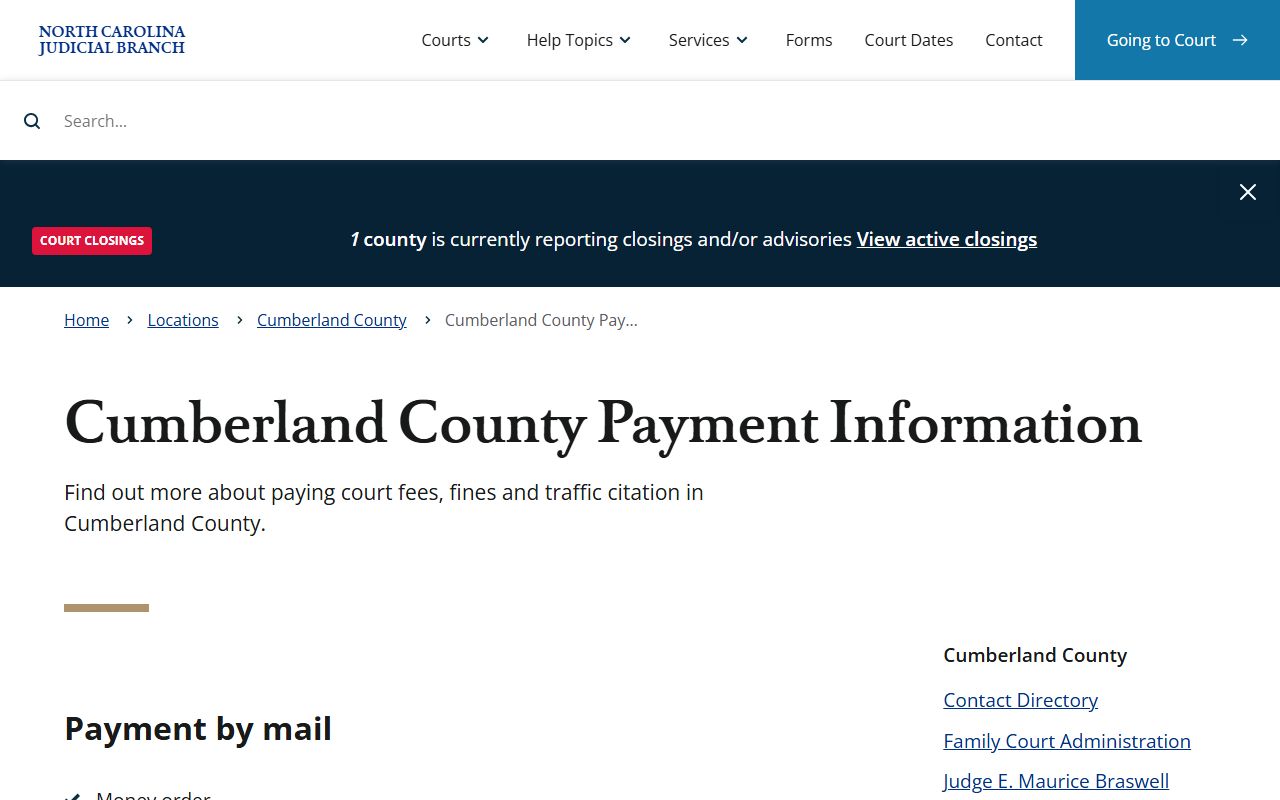
Eligible traffic citations may be paid by mail, in person, or online with a card.
| Item | Amount |
|---|---|
| Marriage license | $60 |
| Certified marriage copy (in person or mail) | $10 |
| Certified marriage copy (Online Vitals) | $14.50 |
| Court copy and certification fees | See state court cost charts |
Note: copy and certification fees follow the current state court cost charts, so confirm the exact amount with the clerk before you pay.
How to Interpret Cumberland County Court Records
Court files use shorthand. Knowing a few terms helps you read a case fast. A "disposition" is the outcome of a charge. "Dismissed with prejudice" means the case is closed for good. "Dismissed without prejudice" means it can be refiled if the law allows. A "continuance" is just a postponed hearing.
An arrest is not a conviction. A charge shows what police or the State allege. A conviction is a judgment of guilt entered by the court. A person can be arrested, then have charges dropped, dismissed, or reduced. Read the disposition before you assume an outcome. The Portal calendar shows scheduled events, while the Register of Actions shows what has already happened in the case.
Accuracy and Record Limitations
Online records can lag. The Portal FAQ says case summaries and documents post within minutes of upload to the state Odyssey system, but daily volume can slow things. A new arrest may not show right away because booking takes hours. The Portal is also not the official court record.
Note: Always confirm a case detail with the Clerk of Superior Court before you rely on it for any legal or financial decision.
History of Cumberland County Courts
Cumberland County began in 1754, and the Register of Deeds still holds land records back to that year. Fayetteville has long served as the county seat and the regional court center. The current main courthouse carries the name of Judge E. Maurice Braswell. The building now ties court functions, the Register of Deeds, and county offices into one downtown complex.
The system keeps changing. The state moved Cumberland County onto the eCourts Odyssey Portal for online records and payments. In June 2025, the Judicial Branch deployed eCourts kiosks with scanners and printers to county courthouses, Cumberland among them. New judges have joined the bench too, including a District Court appointment in April 2025 and a Superior Court appointment to District 14B in December 2025.
Frequently Asked Questions
How do I search Cumberland County court records online?
Use the North Carolina eCourts Portal linked from the Cumberland County Judicial Branch page. Smart Search finds public cases by party name, case number, citation number, attorney name or bar number, business name, cross-reference number, or nickname. Filter to Cumberland County when you can. The Portal shows public case summaries and documents, but the official record and certified copies come from the Clerk of Superior Court.
Do I need an account to use the Portal?
No. Anonymous users can search and view public court information for free. Registration is optional and lets you save cases to "My Cases." Elevated access is a separate level. It requires approval based on a verified business need and statutory authority, and it is needed only for restricted case types.
Where is the Cumberland County courthouse?
The Judge E. Maurice Braswell Cumberland County Courthouse is at 117 Dick St., Fayetteville, NC 28301. The main phone is (910) 475-3000. Hours are Monday through Friday, 8:00 AM to 5:00 PM. The courthouse is closed on weekends. Public entry is at street level, and elevators reach the office floors.
More on the Cumberland County Court Records FAQ page.