
Arrest Records in Cumberland County
An arrest record is created when a person is taken into custody and processed through booking at the Cumberland County Detention Center. The Cumberland County Sheriff's Office, under Sheriff Johnathan Morgan, operates the detention center at 131 Dick Street in Fayetteville. Local police departments in the county also make arrests, but those individuals are often transported to the Sheriff's facility for booking. The resulting record captures the person's name, the date of arrest, and the charges listed at the time of booking. It does not establish guilt.
Arrest records are distinct from criminal court records. The arrest record comes from the law-enforcement side of the process. It lives with the Sheriff and is governed by N.C. Gen. Stat. § 132-1.4, which treats criminal investigation and law-enforcement records differently from ordinary administrative public records. Once charges are formally filed in court, a separate criminal court record is created through the Clerk of Superior Court. Full court case history is covered on the Cumberland County court records page.
How to Search Cumberland County Arrest Records
The fastest way to search recent Cumberland County arrest records is through the Sheriff's Active Inmate Search. The tool is free and publicly available. It shows who is currently in custody at the Cumberland County Detention Center, which means a person who was arrested, booked, and has not yet been released. Keep in mind that pre-booking can take four hours or more after an arrest, and the intake and booking process itself runs four to eight hours. A very recent arrest may not appear right away.
The official Sheriff's Records Management page lists additional resources for incident reports and crime data. The Sheriff operates a report center online for some records, though accident reports are not available online and must be requested separately.
The screenshot below is from the Cumberland County Sheriff's Office records management page.
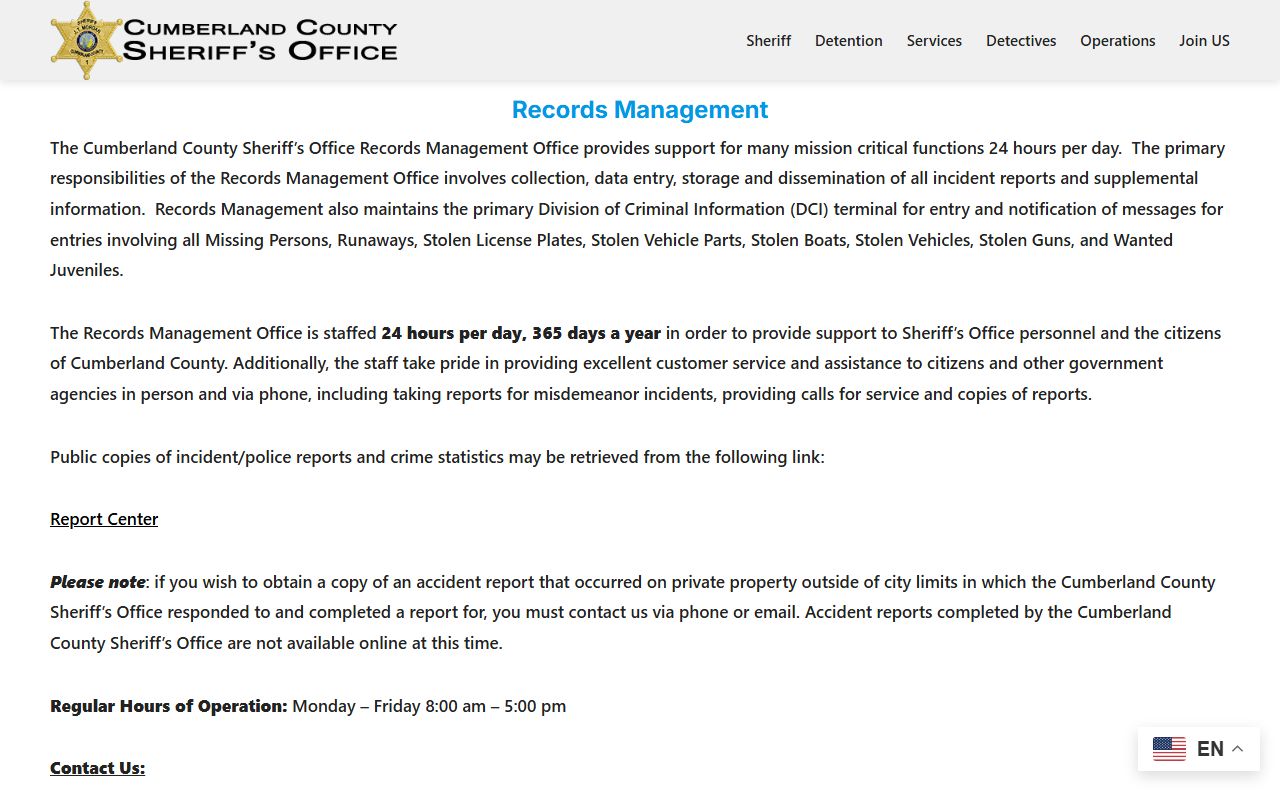
That page links to the report center and explains what records can be accessed online and what must be requested by phone or email.
- Go to cumberlandsheriffnc.gov/active-inmate-page/. The page embeds the detention center's live inmate search.
- Enter a last name. The last name field is required. The first name field is optional but narrows results when the last name is common.
- Click Submit. Results show the date arrested, the person's name, and a More Details link for each match.
- If no result appears for a recent arrest, allow up to 12 hours for intake to complete, then search again or call the Information Desk at (910) 672-5630.
For state prison, probation, and parole records, the NC Department of Adult Correction offender search covers people in the state system back to 1972. That search does not include county jail inmates. For someone transferred to federal custody, the Bureau of Prisons inmate locator is the right tool.
Cumberland County Active Inmate Search Fields
The Active Inmate Search at the Cumberland County Sheriff's site is a straightforward form. It exposes two search inputs and returns a list of matching current detainees. The table below shows the exact fields from the official search form at the detention center portal.
| Field Label | Type | Required | Notes |
|---|---|---|---|
| First Name | Text | No | Up to 20 characters; narrows results when last name is common. |
| Last Name | Text | Yes | Up to 40 characters; marked required with a red asterisk. |
| Submit | Button | n/a | Runs the search. |
| Reset | Button | n/a | Clears both fields. |
Results list the date arrested, the detainee's name, and a More Details link. The search footer notes the data is provided under N.C.G.S. 132-1.4 and excludes information not subject to public disclosure. Accident reports are not included and must be obtained through NCDMV. For fuller inmate information and booking details, see the Cumberland County inmate records page.
The Booking Process at Cumberland County Jail
After an arrest, the person may first go to a local police station for interviews, reports, or forms before arriving at the jail. DWI arrests may involve breath or blood chemical testing that adds time before booking starts. The Sheriff's Detention Center page explains that pre-booking alone can take four hours or more. Once a person arrives at the Cumberland County Detention Center, intake and booking typically runs four to eight hours.
During that window, staff work through a defined set of steps. Each step generates data that later becomes part of the arrest record. The steps, in the order the Sheriff describes them:
- Medical screening to identify immediate health needs.
- Mental health screening.
- Identification verification.
- Warrant check to determine if other holds exist.
- Clerical processing and contraband search.
- Photograph (mugshot) and fingerprinting.
- Computer entry of arrest and charge data.
- Bail determination by a judicial official, including the magistrate.
- Court-date setting.
Some people are released during or right after this process, either because the magistrate sets a low bond they can meet or because the charge qualifies for release on their own recognizance. Intoxicated individuals may be held up to 24 hours or longer until staff determines it is safe to release them. Those who are not released are assigned to a housing unit based on classification criteria.
Note: because booking takes time, the active inmate search may not reflect an arrest for up to 12 hours after custody begins.
Mugshots and Cumberland County Arrest Photos
Booking photographs, called mugshots, are taken during intake as one of the standard steps. North Carolina treats law-enforcement records, including booking photos, under N.C. Gen. Stat. § 132-1.4. That statute allows agencies to withhold criminal investigation and law-enforcement records, meaning mugshots are not automatically released on demand the way standard administrative documents are. The Sheriff's Active Inmate Search page shows a placeholder image on the search form but does not publish a public mugshot gallery for all detainees.
The Sheriff's page notes that some information is not subject to disclosure under state public records law and is not accessible through the public inmate site. If a specific booking photo is needed for a legitimate legal purpose, contact the Cumberland County Sheriff's Office directly. Be aware that information not releasable under state law can only be provided by court order.
The screenshot below comes from the Cumberland County Sheriff's Office official site.
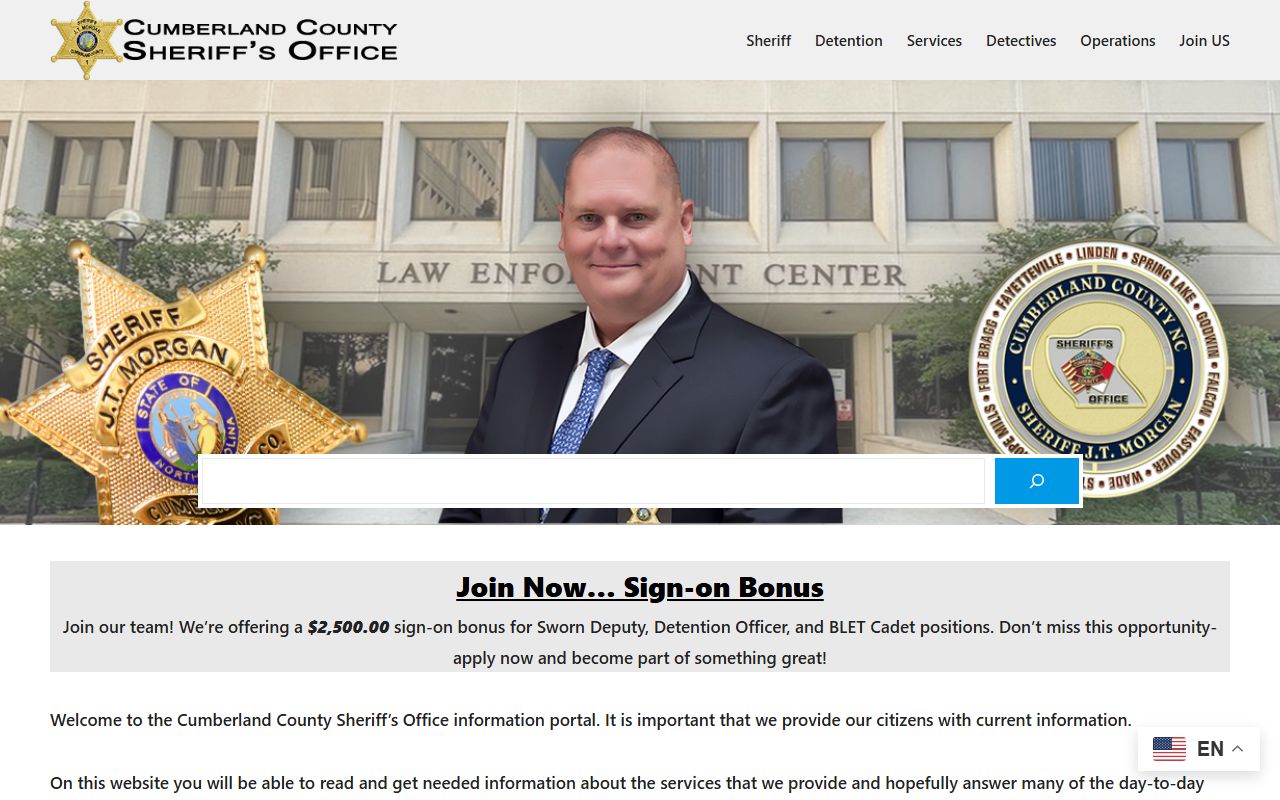
The Sheriff's homepage links booking and release information, records management, and inmate services.
Arrest Record vs. Criminal Court Record
People often search for what they call "criminal records" when they really want to see whether someone was arrested, what the charges were, and what happened next. Those are two separate records generated by two separate systems. An arrest record comes from the Sheriff or a police department at the time of booking. A criminal court record is created by the Clerk of Superior Court once charges are formally filed in court. The two may cover the same event, but they are not the same document and they are not stored in the same place.
| Arrest Record | Criminal Court Record | |
|---|---|---|
| Source | Sheriff or Police | Clerk of Superior Court |
| Created When | At booking | When charges are filed |
| Primary Contents | Name, date arrested, charges at booking, mugshot, fingerprints | Case number, pleadings, motions, hearings, disposition, sentence |
| Where to Search | Sheriff Active Inmate Search; Sheriff Records Management | NC eCourts Portal; Clerk of Superior Court |
| Legal Status | Law-enforcement record under § 132-1.4 | Public court record under Chapter 7A and Chapter 132 |
For the full court file, case history, and official copies, use the court records page, which covers the NC eCourts Portal and the Clerk of Superior Court.
Charges vs. Convictions in Cumberland County
A charge is a formal accusation. It says a person is alleged to have broken a law. The standard to charge someone is probable cause, which is a much lower bar than what a court needs to convict. When you find a Cumberland County arrest record showing a list of charges, those are allegations that have not been tested in court yet. They may change. Some get dismissed. Others get reduced. A few lead to conviction, and some result in acquittal.
| Charge | Conviction | |
|---|---|---|
| What It Means | Formal accusation by the State | A finding of guilt, by verdict or guilty plea |
| Legal Standard | Probable cause | Beyond a reasonable doubt |
| Who Can Charge | District Attorney; grand jury indictment | Judge or jury after trial; judge after a plea |
| Effect on Record | Appears in arrest data and court filing | Enters the criminal history and affects sentencing |
| Public Record | Yes, unless restricted or expunged | Yes, unless expunged or sealed |
The Cumberland County District Attorney, reachable at (910) 475-3010, prosecutes state criminal cases in District 14. A dismissal by the DA or an acquittal at trial means a conviction never occurred, but the original arrest record and court filing may still be publicly visible unless expunged.
What Is Public and What Is Restricted
North Carolina's public records framework in Chapter 132 makes most government records accessible, but law-enforcement and court records carry their own layers of restriction. The Sheriff's Active Inmate Search footer tells users plainly: the search does not include information that is not subject to disclosure under state public records law, and information outside that scope can only be provided by court order. Understanding which category a record falls into saves time before making a request.
The screenshot below is from the North Carolina General Statutes page for N.C.G.S. § 15A-145.5, the main expunction statute.
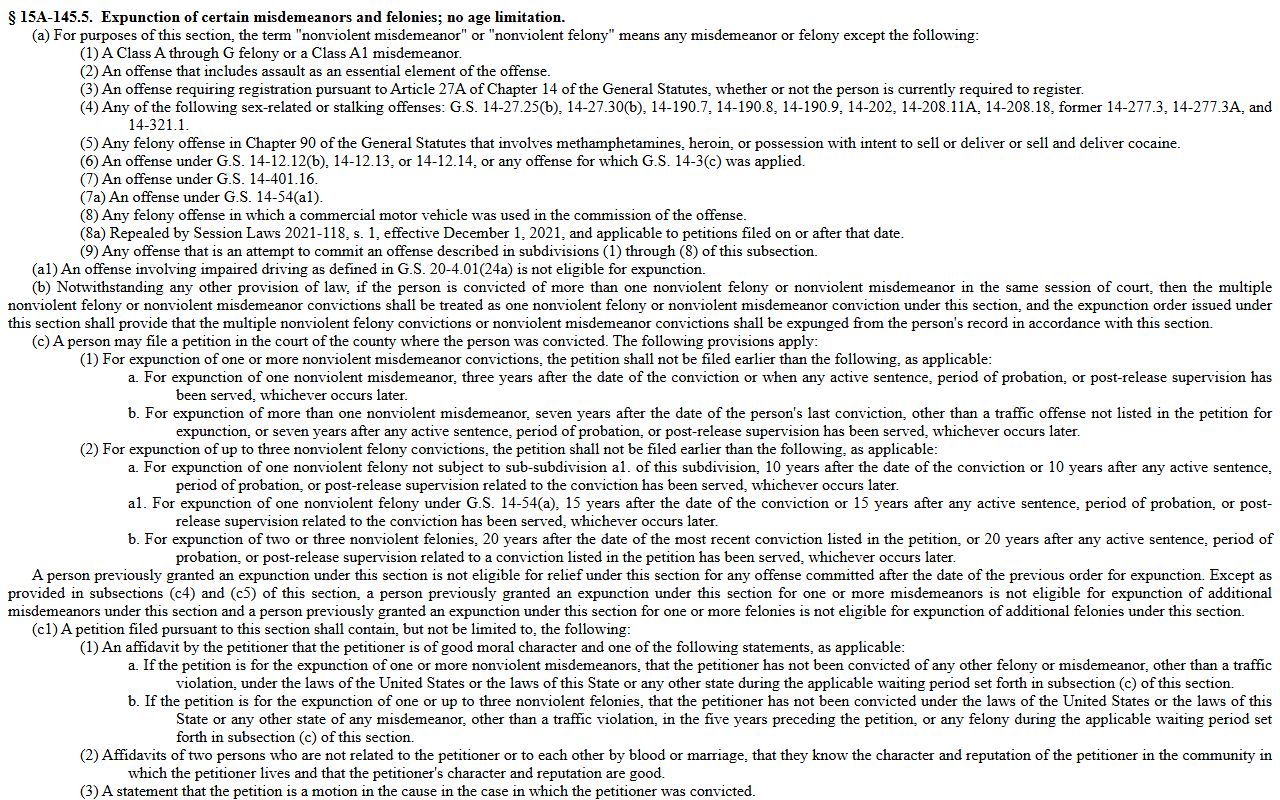
That statute governs eligibility for expunging certain misdemeanors and felonies in North Carolina, which affects whether a Cumberland County arrest record remains visible on public searches.
The categories below describe what is generally open versus what is not:
- Generally public: Active inmate list (while in custody), returned warrant cases in eCourts, criminal court filings where not sealed, conviction records, most court calendars.
- Restricted by law: Juvenile records under N.C. Gen. Stat. § 7B-3000; expunged records after an order under § 15A-145.5; confidential expunction files under N.C. Gen. Stat. § 15A-151; unreturned criminal warrants (restricted in eCourts Portal); adoption records under § 48-9-102; mental health client records under § 122C-52.
- No public online portal: Accident reports (request through NCDMV or Sheriff by phone/email); criminal investigation records held by law enforcement that are not yet part of a public court filing.
Juvenile Arrest Records in Cumberland County
Juvenile records are among the most restricted in North Carolina. N.C. Gen. Stat. § 7B-3000 restricts inspection of juvenile court records to authorized persons, which generally means the juvenile, their attorney, certain state agencies, and anyone else granted access by statute or court order. The public cannot simply request a juvenile arrest or court file the way they can request an adult court record.
The screenshot below is from the official NC General Statutes page for N.C.G.S. § 7B-3000, the juvenile records confidentiality statute.
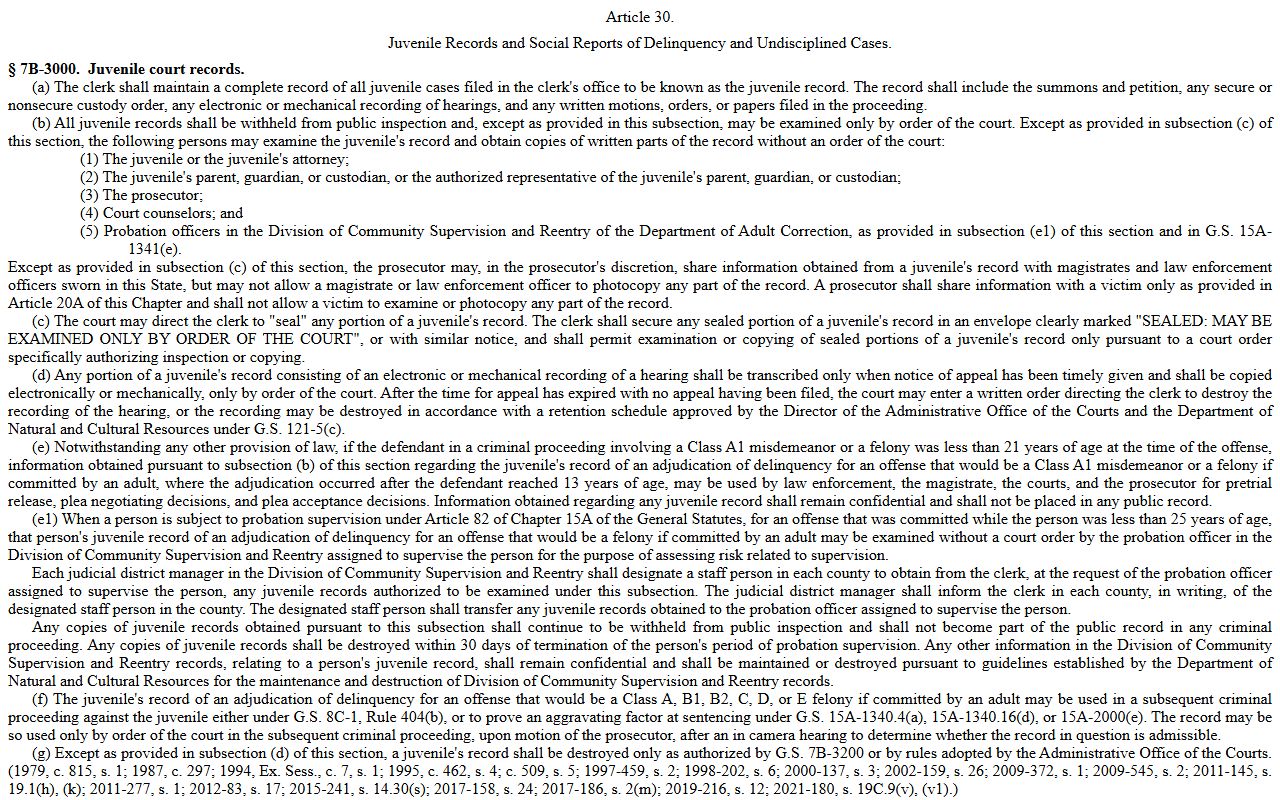
This statute governs the inspection and release of juvenile court records in North Carolina and directly limits what the public can see regarding arrests of minors.
Cumberland County local forms include filings specific to juvenile cases, but those records are not publicly searchable through the eCourts Portal without elevated access and legal authority. Anyone seeking juvenile records for a legitimate purpose should consult the Clerk of Superior Court at the courthouse and be prepared to show the legal basis for the request.
Sealed vs. Expunged Records in North Carolina
Sealing and expunction are related but different processes, and they produce different results for a Cumberland County arrest or criminal record. A sealed record still exists in the court system but is hidden from public view. An expunged record is treated more aggressively: public access is removed, agencies must purge or restrict the record, and under North Carolina law the person may generally state that the arrest or charge never occurred. Both processes require legal action through the courts.
| Sealed | Expunged | |
|---|---|---|
| Visibility to Public | Hidden from public access | Removed from public access; record treated as not occurring |
| Law Enforcement Access | Limited; depends on court order or statute | Very limited; controlled by N.C.G.S. § 15A-151 for confidential files |
| eCourts Portal | Blocked in Portal for sealed/restricted cases | Removed from Portal and agency records after order |
| How Obtained | Court order in specific circumstances | Petition under applicable Chapter 15A statute; court order required |
| Eligibility | Case-by-case, limited statutory grounds | Depends on charge type, disposition, waiting period, prior record; see § 15A-145.5 |
North Carolina expunction eligibility changes when the General Assembly updates the statutes, so the rules that applied five years ago may not apply today. N.C. Gen. Stat. § 15A-145.5 covers expunction of certain misdemeanors and felonies. After an expunction is granted, N.C. Gen. Stat. § 15A-151 controls the confidential files that certain agencies retain for limited official use. Consulting an attorney or the NC Judicial Branch help resources before filing a petition is strongly advised because common denial reasons include the wrong statute, an ineligible offense class, unpaid fines, a disqualifying prior record, or filing before the waiting period expires.
Note: expunction removes the public record but does not guarantee removal from every third-party database. Verify with the originating court after an order is entered.
Statewide Criminal Records Search
A search of just the Cumberland County Sheriff's inmate list only shows who is currently in custody in the county. For a broader picture of someone's criminal history across North Carolina, including people who have been convicted, sentenced to state prison, or placed on probation or parole, the state provides additional tools. The NC Department of Adult Correction offender search page pulls together several resources in one place.
State tools available through that page include the NC DAC Offender Public Information Search, which covers state prison and community supervision records back to 1972; the Automated Sentence Calculator; NC SAVAN and VINELink for victim and general custody notifications; the NC SBI Sex Offender Registry; and the Interstate Compact offender search for people on supervision in other states. None of these tools include county jail records, so someone who was arrested, made bail, and never went to state prison may not appear on any of them. The county's active inmate search is still the right starting point for recent local arrests.
Background Check Considerations
Searching Cumberland County arrest records online gives you a snapshot of what is publicly visible at a given moment. That is useful for general research, but it is not a background check in the legal sense. The federal Fair Credit Reporting Act governs the use of consumer reports, including criminal history checks, for decisions about employment, credit, housing, and insurance. FCRA-regulated background checks must be obtained through a licensed consumer reporting agency, not through a general court records search.
A few things to keep in mind when using online arrest data. First, the active inmate search only shows current detainees, not everyone who has ever been arrested in Cumberland County. Second, records that have been expunged may no longer appear in official sources but could still show up in third-party databases that have not updated their records. Third, charges that were dismissed or resulted in acquittal may still be visible in court records even though no conviction occurred. Arrest data reflects what happened at one point in time and does not include every update that came afterward.
Important: This site is not a consumer reporting agency. Information found here may not be used for employment screening, tenant screening, credit, insurance, or any other FCRA-regulated purpose.
Federal Arrest and Criminal Records
Cumberland County sits in the federal Eastern District of North Carolina. Federal criminal cases, which include drug trafficking, bank robbery, federal firearms charges, and similar matters, are handled by the U.S. District Court for the Eastern District of North Carolina. The Fayetteville federal courthouse is located at 301 Green Street, Unit 301, Fayetteville, NC 28302. Federal cases in that courthouse are prosecuted by the U.S. Attorney's Office for the Eastern District of North Carolina, which covers 44 eastern North Carolina counties and maintains offices in Fayetteville and Raleigh.
The screenshot below comes from the U.S. Attorney's Office for the Eastern District of North Carolina official page.
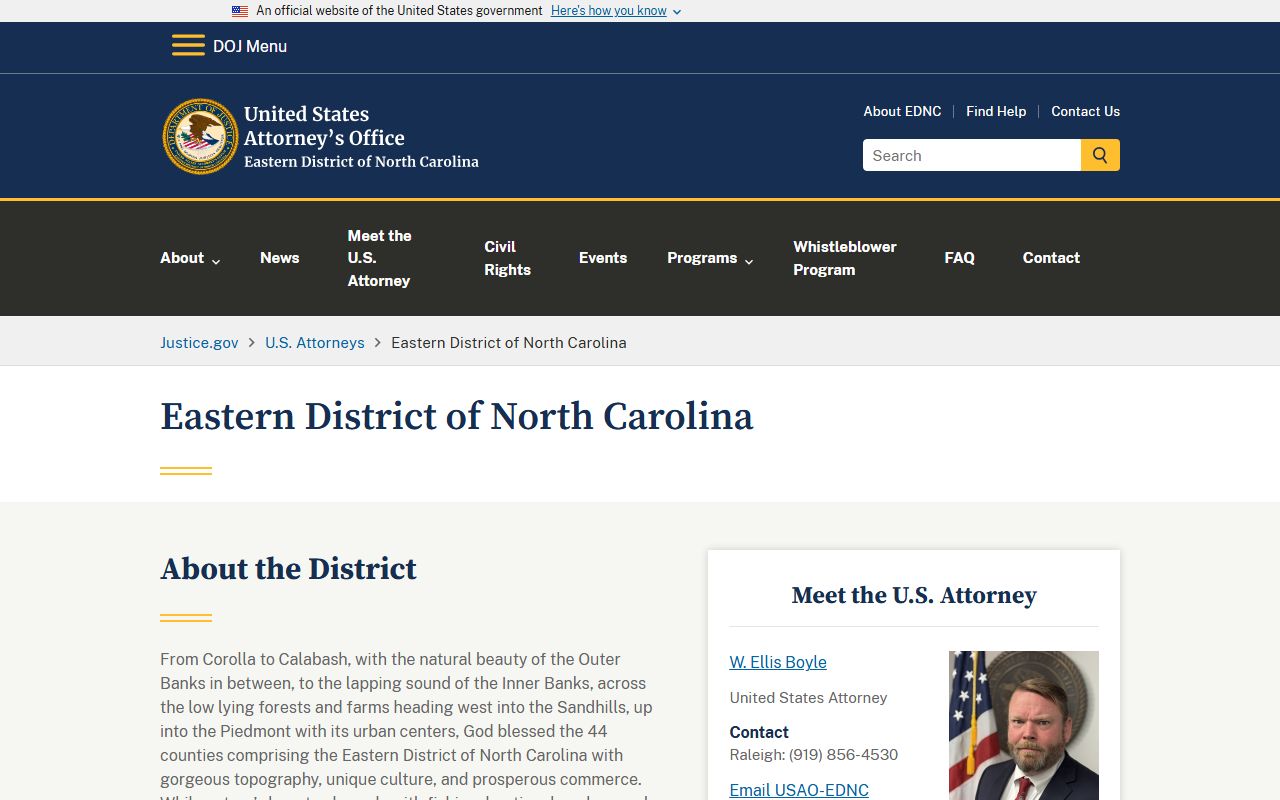
The USAO-EDNC page covers press releases, program information, and contacts for federal criminal matters that originate in Cumberland County and neighboring eastern North Carolina counties.
Federal court records are not on the NC eCourts Portal. They are accessed through PACER, the federal electronic records system. A PACER account is required and per-page fees apply, though small accounts receive a quarterly fee exemption. For federal inmates, use the Bureau of Prisons inmate locator, which accepts a name or BOP register number.
Criminal Court Case History
Once the District Attorney files charges in court, the case moves to the Clerk of Superior Court and becomes a criminal court record. Misdemeanor and infraction cases are heard in District Court. Felony cases start in District Court for preliminary proceedings and then move to Superior Court, where a grand jury indictment formalizes the charges. Both court types for Cumberland County are in District 14 and use the same courthouse at 117 Dick Street.
Criminal court records are searchable through the North Carolina eCourts Portal. Smart Search lets you look up criminal actions by party name, case number, citation number, or attorney information. The Portal shows the case summary, hearing dates, charges, dispositions, and financial information where applicable. Restricted records, including unreturned warrants and certain confidential matters, require elevated access and are not visible to the public. The official record and certified copies come from the Clerk of Superior Court at (910) 475-3000. For a full walkthrough of how to use the Portal for criminal case history, see the court records page.
Warrants, the DA, and Related Records
Active warrants in Cumberland County are handled by the Sheriff's Fugitive/Warrants Section. That division enters warrants and orders for arrest, including grand jury indictments, into both the local PISTOL records system and the statewide DCI and national NCIC databases for felonies and serious misdemeanors. There is no official public warrant search list online. The eCourts Portal marks unreturned criminal warrants as restricted and requires elevated access to view them.
If you need to know whether a warrant exists for a specific person, the most direct options are to check the eCourts Portal for related criminal case activity, call the Sheriff's Fugitive/Warrants Admin Support line at (910) 672-5660 during business hours (Monday-Friday 8:00 AM-5:00 PM), or consult an attorney. An outstanding warrant can result in arrest. For more detail on the warrant process and how to resolve one, see the Cumberland County warrant records page.
The District Attorney's office at (910) 475-3010 prosecutes state criminal matters in District 14. The DA does not conduct public criminal record searches but can be contacted by parties involved in active cases. For DUI/DWI charges, which are criminal matters rather than simple traffic infractions, the criminal records process described above applies. Those records also appear on traffic court records searches because DWI is often an entry point into the criminal system for first-time offenders.