
No Official Public Warrant List in Cumberland County
The Cumberland County Sheriff's Office does not publish a public active-warrant search database on its website. Many counties in other states offer a searchable online warrant list, but no such portal was located for Cumberland County during research of official sources. The Fugitive/Warrants Section page describes the division's duties, contacts, and hours, but it does not link to or reference an open warrant search tool. Unofficial websites sometimes claim to list active warrants, but those sources are not maintained by the Sheriff or any court and their accuracy cannot be verified from official records.
What is available publicly is limited but useful. The North Carolina eCourts Portal can surface criminal case records where a warrant has been returned and a case has been opened. That means a warrant-related case may show party information, charges, court dates, and dispositions once the case is active in the court system. Warrants that have not yet been returned, meaning the subject has not been arrested or appeared, are restricted under the Portal's access rules and are not visible to the general public.
The clearest way to find out whether someone has an outstanding Cumberland County warrant is to call the Fugitive/Warrants Section at (910) 672-5660 during business hours, or to consult an attorney who can make inquiries on your behalf.
| Search Method | Type | What It Covers |
|---|---|---|
| Public warrant search portal | N/A | No official Cumberland County public warrant search portal located. |
| NC eCourts Smart Search | Text / filter | Returned or charged warrant-related criminal cases searchable by party name or case number. |
| Sheriff Fugitive/Warrants Admin Support | Phone | Direct contact for warrant inquiries: (910) 672-5660, Mon-Fri 8:00 AM-5:00 PM. |
| After-hours Watch Commander | Phone | Emergency contact only: (910) 677-5432. |
Note: the eCourts Portal is not the official court record; always confirm warrant or case details with the Clerk of Superior Court or the Fugitive/Warrants Section.
Cumberland County Fugitive/Warrants Section
The Cumberland County Sheriff Fugitive/Warrants Section is the office responsible for warrant entry, subject location, and fugitive apprehension. It is a specialized unit within the Sheriff's Office, and it is the only section authorized to return wanted fugitives apprehended outside North Carolina to Cumberland County for formal charging and trial on felony matters.
The screenshot below was captured from the official Sheriff Fugitive/Warrants Section page, which outlines the division's duties and contact information.
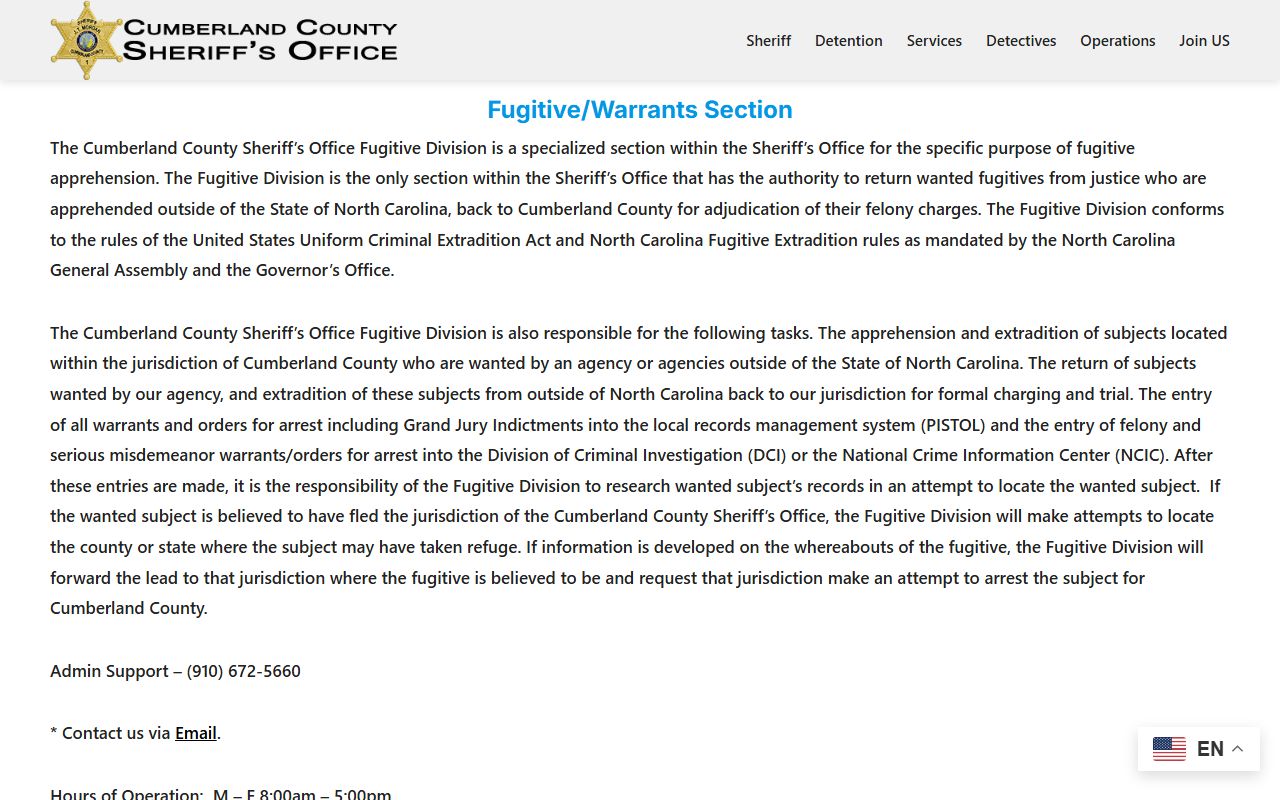
The page confirms the Admin Support line, hours, and after-hours Watch Commander contact for the Fugitive/Warrants Section.
The section's day-to-day work covers three main areas. First, it handles warrant entry. Every warrant and order for arrest issued in Cumberland County, including grand jury indictments, is entered into the local records management system called PISTOL. Second, it manages fugitive apprehension. After a warrant is entered, the division researches the wanted subject to locate them. If a subject appears to have left the area, the section tries to identify the county or state of refuge and forwards leads to the relevant jurisdiction. Third, it manages extradition in both directions, bringing subjects wanted by Cumberland back from other states and returning people wanted elsewhere who are found in Cumberland County.
The Fugitive/Warrants Section also handles warrants issued by outside agencies for subjects who happen to be in Cumberland County. When such a person is found, the Sheriff's Office works with the requesting agency on pickup or transport.
Cumberland County Sheriff Fugitive/Warrants Section
131 Dick Street
Fayetteville, NC 28301
Admin Support: (910) 672-5660
Main Sheriff: (910) 323-1500
After-hours Watch Commander: (910) 677-5432
Mon-Fri 8:00 AM - 5:00 PM
Warrant Entry: PISTOL, DCI, and NCIC
When a court issues a warrant or order for arrest in Cumberland County, the Fugitive/Warrants Section enters it into the local records management system known as PISTOL. This keeps the warrant in the Sheriff's local database and makes it immediately visible to officers in the county. PISTOL is not a public database. Members of the public cannot search it directly.
For felony warrants and serious misdemeanor warrants, the section also enters them into the Division of Criminal Information, called DCI, or the National Crime Information Center, called NCIC. DCI is the North Carolina statewide law enforcement network. NCIC is the FBI's federal database used by law enforcement across the country. Once a warrant is in NCIC, any officer who runs the subject's name during a traffic stop, booking, or background inquiry anywhere in the United States will see the warrant. This is why people with outstanding felony warrants are at risk of arrest during routine encounters with law enforcement, even in a different state.
The entry into DCI or NCIC does not create a public record. These systems are restricted to credentialed law enforcement users. However, the act of being entered means the warrant is active and enforceable nationwide from the moment of entry.
Bench Warrants and Orders for Arrest in Cumberland County
Warrants in North Carolina come in a few forms. The two most common for criminal matters are the arrest warrant and the order for arrest. Understanding the difference matters if you are trying to find out what kind of process led to a warrant in a Cumberland County case.
An arrest warrant is issued by a magistrate or judge before a person is charged or at the start of a criminal proceeding. It authorizes law enforcement to take the named person into custody and bring them before a court. A magistrate in Cumberland County handles initial appearances, and magistrates have authority to issue warrants and orders in certain statutory matters. Magistrates are District Court officers under North Carolina's court structure.
An order for arrest, sometimes called an OFA, is issued by a judge or clerk during an existing case when a defendant fails to appear for a required court date, violates a condition of release, or otherwise triggers a court-ordered pickup. A bench warrant is the common term for this type of order, reflecting the fact that it comes from the bench of the court rather than from an initial magistrate. Grand jury indictments also generate orders for arrest when the indicted person is not already in custody.
- Arrest Warrant
- A judicial document authorizing law enforcement to take a specific person into custody, issued before or at the start of a criminal case based on probable cause.
- Order for Arrest (Bench Warrant)
- A court order issued during an active case, typically for failure to appear or a release violation; also called a bench warrant because it originates from the presiding judge or clerk.
- Extradition
- The formal legal process by which a person in one state is returned to the state where they are wanted for trial or sentencing; North Carolina follows the Uniform Criminal Extradition Act.
- Fugitive
- A person who has fled the jurisdiction to avoid arrest or who is wanted under an active warrant and cannot be located by local law enforcement.
The Fugitive/Warrants Section enters both arrest warrants and orders for arrest into PISTOL and, where eligible, into DCI and NCIC.
Unreturned Cumberland County Warrants Are Restricted
The NC eCourts Portal's official FAQ specifically lists "Criminal Warrants Unreturned" as one of the restricted case types that require elevated access. Public users, including anonymous visitors and registered standard users, cannot see unreturned warrants through the Portal. Elevated access is granted only to users with a verified business need and statutory authority. That group does not include general members of the public.
A warrant becomes "unreturned" when it has been issued but the subject has not yet been arrested or brought before the court. The warrant stays restricted in the Portal until it is executed and the case moves forward. Once a warrant is returned, meaning the person has been arrested or appeared, the resulting criminal case becomes part of the public criminal record and may appear in a Smart Search on the Portal.
This restriction is part of the same framework that keeps juvenile records, protective orders, and certain other case types away from public Portal access. Under N.C. Gen. Stat. § 7A-109.2, remote electronic access to court records is subject to rules set by the North Carolina Supreme Court, and those rules allow the Judicial Branch to restrict access to categories of records that could compromise safety or ongoing law enforcement actions.
The screenshot below comes from the Cumberland County Sheriff Sex Offenders page, which sits within the same section of the Sheriff site as the Fugitive/Warrants unit.
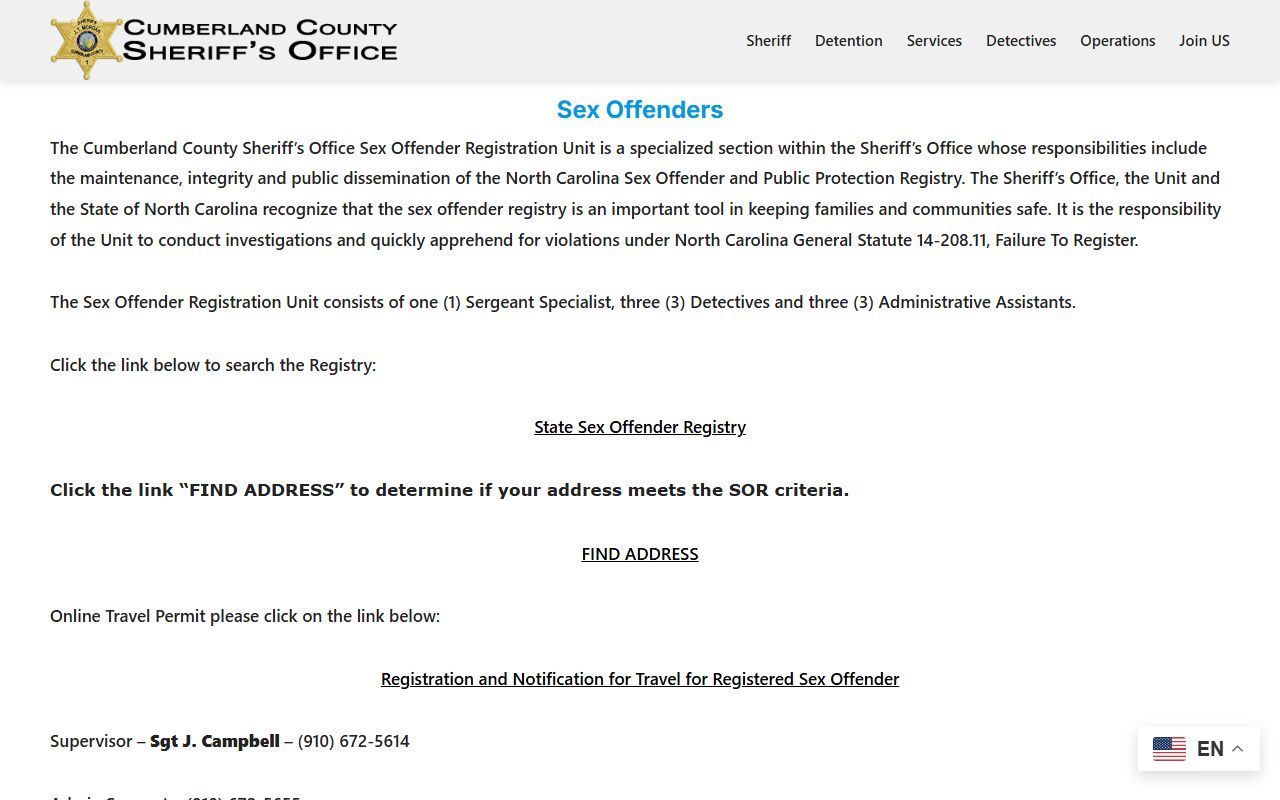
The Sheriff Sex Offender Registration Unit and the Fugitive/Warrants Section are both part of the same division of the Cumberland County Sheriff's Office, which is why the NC SBI Sex Offender Registry is linked from the same area of the site.
Extradition from and to Cumberland County
North Carolina follows the Uniform Criminal Extradition Act, a model law adopted by most states that sets the process for returning fugitives across state lines. The Cumberland County Sheriff's Fugitive/Warrants Section is the only authorized unit within the office that can travel outside North Carolina to retrieve a wanted person and bring them back to Cumberland County for felony adjudication.
The process works in two directions. When a Cumberland County warrant subject is found in another state, the Fugitive Division identifies where the person is and works with authorities in that jurisdiction to hold them pending extradition. Cumberland County then initiates the formal extradition request through the Governor's office, which is the standard process under the Uniform Criminal Extradition Act. For serious cases, the section sends deputies to physically transport the subject back.
The reverse also applies. When a person wanted by another agency is located in Cumberland County, the Fugitive/Warrants Section holds them and works with the requesting jurisdiction. The subject may waive extradition, which speeds the process, or contest it, which involves a hearing before a Cumberland County judge. Either way, the Sheriff's section handles the coordination and logistics on the Cumberland side.
Extradition is limited by practicality. Not every warrant leads to cross-state extradition. Agencies weigh the severity of the charge, whether the person poses a public safety risk, and the resources required to transport them. Felony charges are far more likely to trigger an extradition effort than minor misdemeanors.
NC SBI Sex Offender Registry
The Cumberland County Sheriff also oversees a Sex Offender Registration Unit, which enforces registration requirements under N.C. Gen. Stat. § 14-208.11. Registered sex offenders in Cumberland County are included in the statewide North Carolina SBI Sex Offender Registry, which is publicly searchable. The Sheriff's site links directly to this registry and references it as the official tool for locating registered offenders in the county.
The screenshot below was captured from the official North Carolina SBI Sex Offender Registry, which allows public searches by name, address, or county.
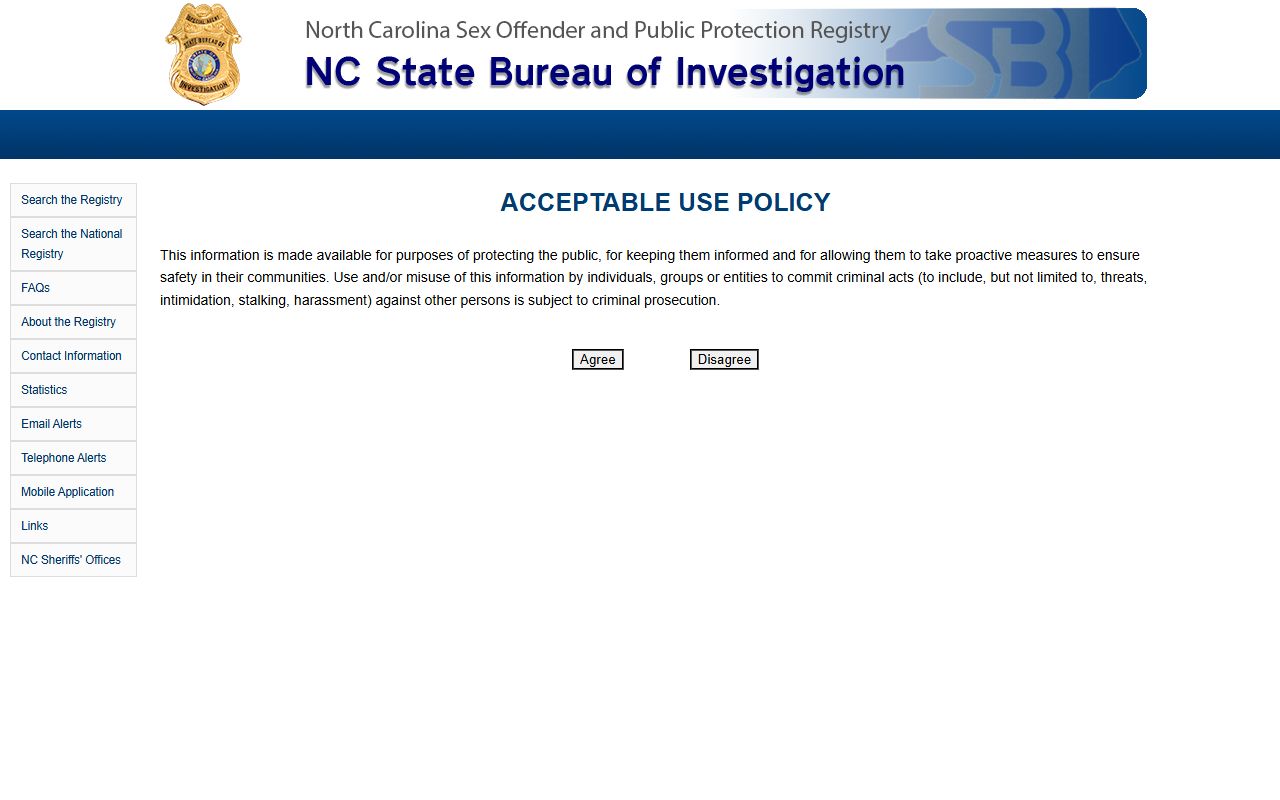
Using Cumberland as the county filter narrows results to offenders registered in the county, which can include people on active parole or supervision.
The sex offender registry is separate from warrant records, but the two topics often come up together because violations of sex offender registration requirements can themselves generate new warrants. Failure to register as required is a criminal offense under § 14-208.11, and the Fugitive/Warrants Section would handle a warrant arising from that charge the same way it handles any other. Anyone researching whether a person has current warrants and also has a sex offender history may find it useful to check both the eCourts Portal and the SBI registry.
How to Resolve a Cumberland County Warrant
Having an outstanding warrant does not go away on its own. The warrant stays active in PISTOL and, if eligible, in DCI and NCIC until it is executed or dismissed by a court. The safest approach is to deal with it directly rather than wait for an arrest at an inconvenient time. The steps below reflect what the Sheriff's Fugitive/Warrants Section outlines and what the eCourts system shows about the resolution process.
- Do not rely on unofficial warrant-check websites. Third-party sites that claim to list active warrants are not maintained by the Sheriff or any court in North Carolina. Their data is often stale, incomplete, or wrong. Acting on false information from an unofficial source can make things worse.
- Check the eCourts Portal for a related criminal case. Go to the NC eCourts Portal and run a Smart Search by the person's name, filtered to Cumberland County. If the warrant has been returned and a case is open, the case summary will show charges, court dates, and any current status.
- Call the Fugitive/Warrants Section during business hours. The Admin Support line is (910) 672-5660, open Monday through Friday, 8:00 AM to 5:00 PM. Staff can confirm whether an active warrant exists for a given person. If you suspect you have a warrant yourself, it is generally better to make this call with an attorney on the line.
- Consult an attorney before turning yourself in. A defense attorney can contact the Fugitive/Warrants Section or the court directly, confirm the warrant details, and arrange a voluntary surrender in a way that may improve your chances at a favorable bond hearing. Going in without counsel and without knowing the charges can result in a harsher outcome than necessary.
- Appear as directed by law enforcement or the court. If told to report to a specific officer, court date, or magistrate, follow those instructions. Ignoring a warrant or court notice leads to additional charges, such as failure to appear, and can make extradition more likely if you leave the state.
- Bond depends on the magistrate and the warrant. After surrender or arrest, a judicial official sets bond conditions. The type of warrant, the charge, your prior record, and the facts of the case all factor in. The magistrate at the Cumberland County Detention Center handles initial bond decisions. A judge may modify bond at a later hearing.
Clearance timing after a warrant is resolved depends on how quickly the court and jail update their systems. The eCourts Portal reflects changes within minutes of upload to the state Odyssey system, but PISTOL, DCI, and NCIC may take additional time to reflect an executed or dismissed warrant. Always confirm with the Fugitive/Warrants Section or the Clerk if you need written proof that a warrant has been cleared.
Using the eCourts Portal for Cumberland County Warrant Cases
The North Carolina eCourts Portal is the closest thing to a public warrant search tool available for Cumberland County, even though it does not show unreturned warrants. What it does show is criminal case information for matters where a warrant has already been executed and the case is moving through the court system. That includes the party's name, charges, hearing dates, dispositions, and bond or financial information where applicable.
The Portal's Smart Search accepts several types of identifiers. You do not need a case number to start. A party name works if you filter to Cumberland County and narrow by case type. The table below shows the search fields available in Smart Search and what they do.
| Field Label | Type | Required | Notes |
|---|---|---|---|
| Party name | Text | No | Search public cases by the defendant or other party name; filter to Cumberland County for best results. |
| Record number / case number | Text | No | Best exact-match field when the case number is known. |
| Citation number | Text | No | Useful for traffic or infraction matters that may have generated a warrant. |
| Attorney bar number | Text | No | Search by attorney identifier if looking for cases an attorney handles. |
| Business name | Text | No | For business-party searches in civil or criminal matters. |
| Advanced filtering: Criminal Actions | Filter/tab | No | Narrows results to criminal case records, the most relevant filter for warrant-related searches. |
Anonymous users do not need to register to run a search. Registration is optional and lets you save cases to a personal list. Elevated access, which would allow viewing of restricted records including unreturned warrants, requires a separate approval process based on verified business need and is not available to members of the general public. For Cumberland County court records beyond warrant-related cases, the Portal covers civil, family, probate, and other criminal matters under the same search interface.
Restricted Warrant Records in Cumberland County
Several categories of warrant-related records are not available to the public in Cumberland County, and understanding which ones are restricted helps set realistic expectations for any search.
Unreturned criminal warrants are the most significant restricted category. As the NC eCourts Portal FAQ states directly, these records require elevated access. They are not searchable by the general public through the Portal, the Sheriff website, or any official county database. This policy exists in part because publicizing an active warrant can alert the subject and complicate law enforcement efforts to execute it.
- Unreturned criminal warrants - restricted under Portal access rules; require elevated access from the NC Judicial Branch.
- Juvenile warrants and orders - juvenile court records are confidential under N.C. Gen. Stat. § 7B-3000; warrants involving minors are not public.
- Protective order cases - listed by the Portal FAQ as a restricted case type requiring elevated access.
- Sealed cases - court orders that seal a record remove it from public access; warrant records associated with sealed cases are not visible online.
- Expunged records - after expunction under Chapter 15A, public access is removed and a confidential file may be maintained for limited official use under N.C. Gen. Stat. § 15A-151.
- Law enforcement investigative records - governed by N.C. Gen. Stat. § 132-1.4; investigative files tied to active matters are not open public records.
If you need access to a restricted record for a legal proceeding, the correct path is a court order or a formal request through counsel. Informal web searches, even on official sites, will not surface these records.