
How to Find Recently Released Cumberland County Inmates
The first step is the Sheriff's Active Inmate Lookup. If a person no longer shows up there, that absence is the earliest sign of release. The roster shows only people currently in custody at the Cumberland County Detention Center. A name that drops from the list has either been released or transferred. It does not tell you which one, which is why a phone call to the Information Desk is the right next move.
The Information Desk can be reached at (910) 672-5630 or (910) 672-5622. Staff can confirm whether a specific person has been released and, if so, give a general picture of the outcome. They cannot always tell you exact release time in advance, and they will not discuss pending transports for security reasons. Those limits are set by the Sheriff's own policy, not by individual officers.
Releases from the Cumberland County Jail happen for several reasons. They include posting bond, receiving a court order to release, completing a sentence, paying a fine or court costs in full, a teletype from another agency removing a hold, or transfer to a different lawful agency. Any one of those paths can move someone off the active roster at any hour of the day or night. The jail does not post a public schedule of upcoming releases.
Sentenced inmates follow a narrower window. The Sheriff states that people serving a sentence are generally released between 6:00 AM and 9:00 PM on the discharge date, unless the court orders something different. Releases outside that window are less common and usually tied to bond, a court order, or a hold being cleared by another agency. If you expect a release on a specific date, call the Information Desk that morning rather than waiting for an online update.
The release process itself takes time. Jail staff conduct a full file review before anyone walks out. That review happens in the order received by the release control officer. On busy days, multiple people may be processing at once, and each one takes as long as the paperwork demands. Property and any remaining account money are returned at the time of release. Clothing stored at booking is given back, and the inmate's cash account balance comes with them when they go.
Setting Up Release Notifications with VINELink
VINELink is the notification platform used across North Carolina under the name NC SAVAN. It covers county jail inmates, state prisoners, probationers, parolees, and registered sex offenders. When you register for an alert, the system sends a message the moment a custody status changes. Alerts go out by phone, email, text, or TTY depending on what you set up. The service is free and confidential. Registration does not require you to explain why you want the notification.
The screenshot below is from the official VINELink custody notification platform, which serves as the NC SAVAN portal for North Carolina.

From this screen you select North Carolina, search by name or ID, and register a contact method for future custody change alerts.
VINELink also lets you check current custody status without registering. A one-time search tells you whether someone is in a facility it tracks. Registration is only needed if you want ongoing alerts when status changes. Victims and family members both use the service, and the system does not distinguish between them.
- Go to vinelink.com and select North Carolina.
- Search by the person's name or ID number.
- Confirm the result is the right person using facility name and other visible identifiers.
- Choose a notification method: phone call, email, or text message.
- Enter your contact information and save the registration. The system will send an alert when custody status changes.
Note: VINELink notifications cover the moment of a status change, not advance notice of a planned release date.
Searching State and Federal Released Inmates
When someone leaves the Cumberland County Detention Center for state prison, they move into the custody of the North Carolina Department of Adult Correction. At that point the county jail record goes cold and the state system picks up. The NC DAC Offender Public Information Search covers state prison offenders, probationers, and parolees. The state database goes back to 1972. It does not include county jail records, so searching it while a person is still held locally will return no result. Once a transfer happens, the state record appears.
The screenshot below comes from the NC Department of Adult Correction offender search page, which lists the state search tools and links to the NC SAVAN custody notification service.
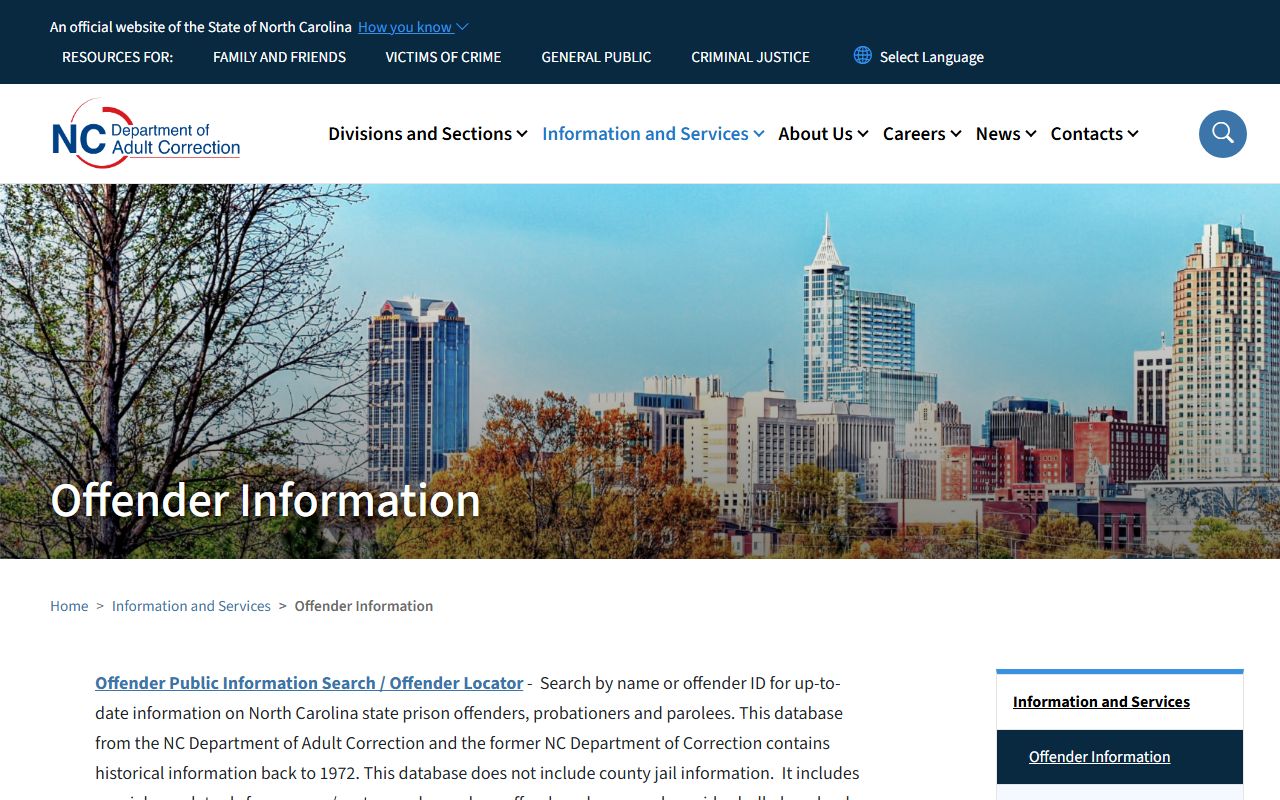
The DAC page also links the NC SAVAN/VINELink registration, the sex offender registry, and the Interstate Compact search for offenders supervised across state lines.
The direct search interface is the NC DAC Offender Public Information Search at the state web application portal. The table below shows its available search fields.
| Field Label | Type | Required | Notes |
|---|---|---|---|
| Last Name | Text | Optional if Offender ID used | State offender search by name. |
| First Name | Text | Optional | Narrows a name search when last name alone returns many results. |
| Offender ID | Text | Optional | Strongest identifier; use if you have the state offender number. |
| Special Tools | Links / Filters | Optional | Includes escapes/captures list, absconders, offender releases, bulk downloads, and ASQ reports. |
The screenshot below shows the direct search interface at the NC DAC Offender Public Information Search.
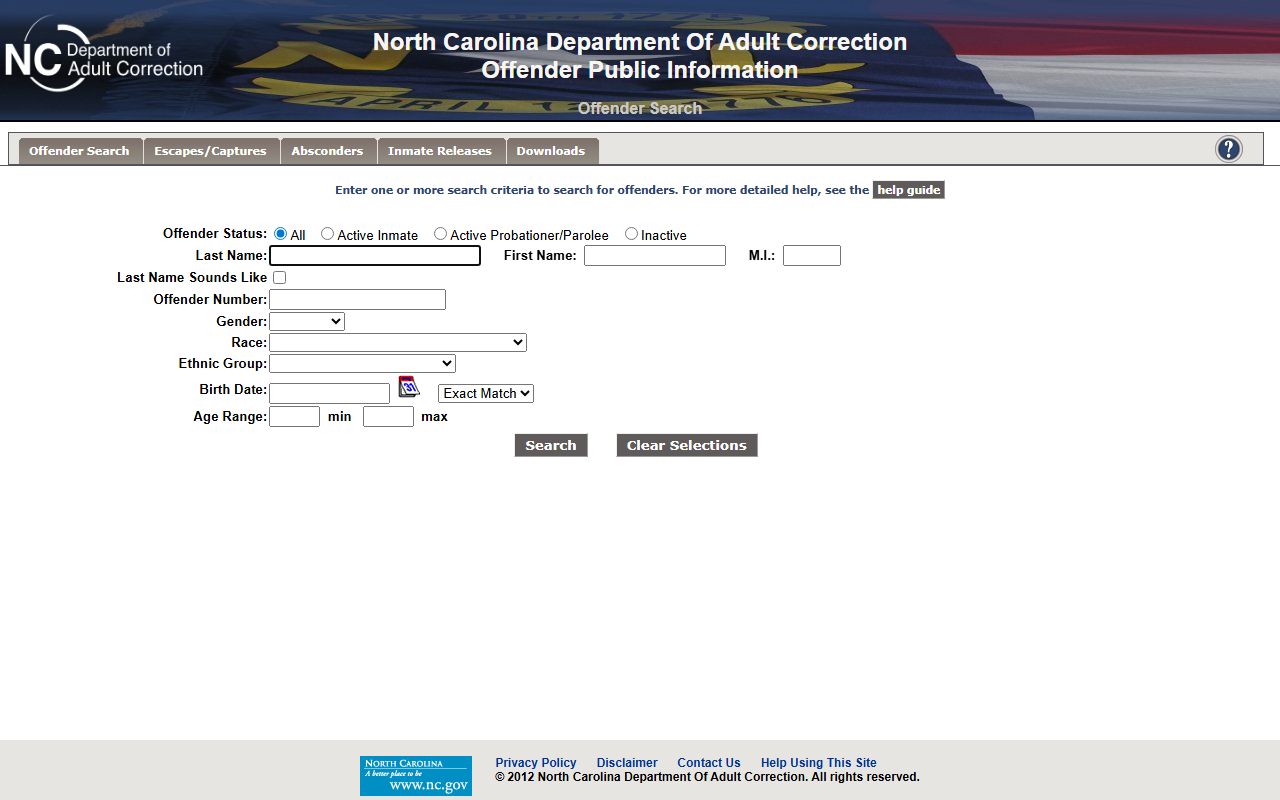
Results show current supervision status, facility assignment, projected release date where published, and offense information for state-level offenders.
For federal inmates, the Bureau of Prisons runs a separate locator at bop.gov/inmateloc. A person held on federal charges after a Cumberland County arrest moves into BOP custody, not NC DAC custody. The county jail, state prison, and federal BOP are three separate systems with no automatic crossover. If you are not sure which system has the person you are looking for, check all three.
| Field Label | Type | Required | Notes |
|---|---|---|---|
| BOP Register Number / DCDC / FBI / INS Number | Text | Optional if name used | Federal number search; use if you have a BOP register number. |
| First Name | Text | Optional | Name search field. |
| Middle Name | Text | Optional | Useful when first and last names are common. |
| Last Name | Text | Optional | Name search field. |
| Race, Age, Sex | Filters | Optional | Demographic filters to narrow large name results in the federal locator. |
The screenshot below comes from the official BOP Inmate Locator, which searches federal custody records by name or register number.
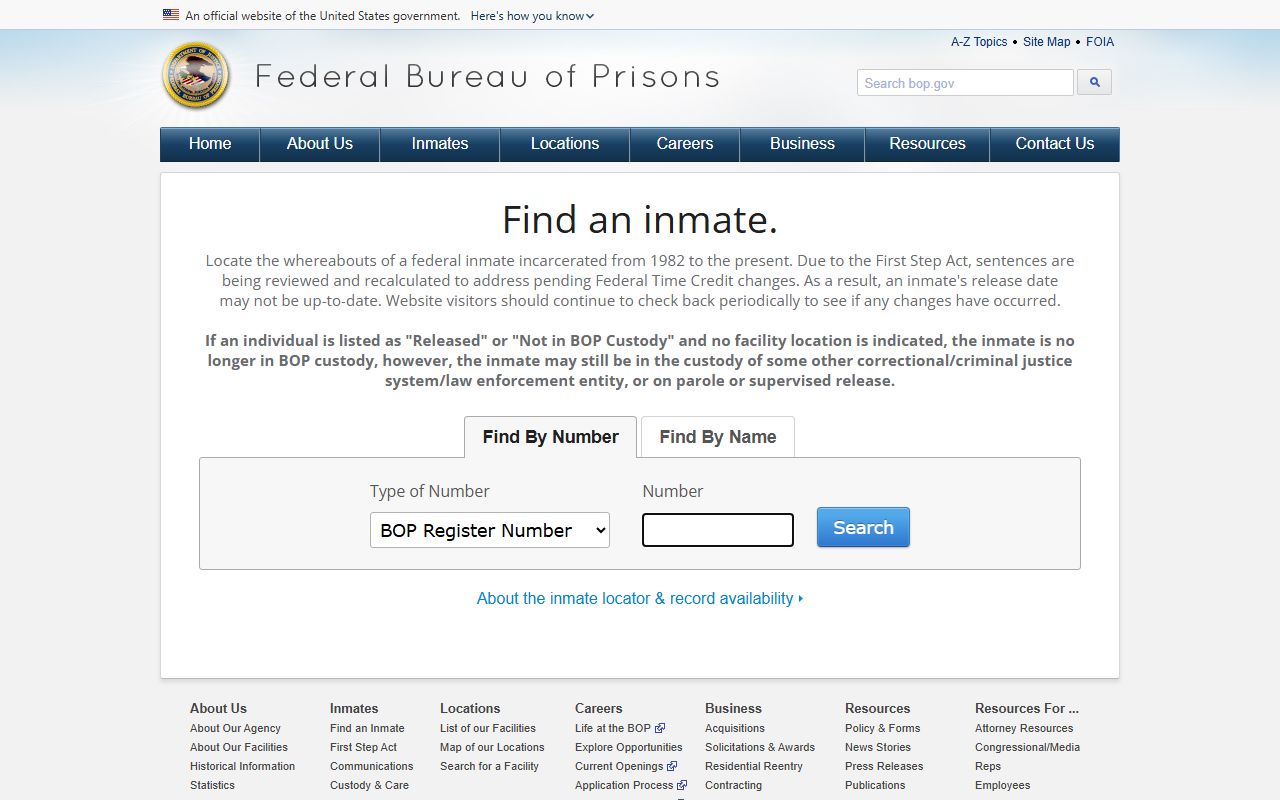
The BOP locator covers people in active federal custody; it does not include those who have completed their federal sentence and been released from BOP supervision.
Verifying Release in Person or by Phone
The most reliable way to confirm a Cumberland County jail release is a direct call to the Information Desk. Two lines are available: (910) 672-5630 and (910) 672-5622. Staff can confirm whether a specific person is still in custody or has been processed out. They cannot give you a future release time with certainty, because that depends on paperwork flowing through the release control officer in order received. Call on the expected release date rather than several days ahead.
Beyond the phone call, three other checks are worth making depending on where the person may have gone after release.
- Active inmate roster: Search the Sheriff Active Inmate Lookup. A name that no longer appears has left county custody.
- NC eCourts Portal: The North Carolina eCourts Portal shows bond changes, court orders, dispositions, and sentence completion events. A disposition marked as released on recognizance, bond posted, or sentence served confirms a court-level action that would trigger release.
- NC DAC search: If you believe the person was transferred to state prison or placed on probation or parole, the NC DAC Offender Public Information Search is the right tool. The state system covers transfers back to 1972 and does not include county jail data.
- VINELink: Register for an alert so the system notifies you automatically when custody status changes rather than checking manually.
- BOP locator: Use this only if the charges were federal. County charges do not route through BOP.
In-person inquiries are possible at the Sheriff's Office at 131 Dick Street, Fayetteville, NC 28301. For most people, the phone call or online search is faster than making the trip. The Sheriff does not publish a public visitor window specifically for release inquiries.
The Sex Offender Registry After Release
People convicted of certain offenses must register with the Cumberland County Sheriff's Sex Offender Registration Unit upon release. North Carolina law requires registration under N.C.G.S. § 14-208.11, and the Sheriff's site links directly to that statute when describing the registration requirement. Failure to comply is a separate criminal offense. Registration involves reporting a home address, workplace, and other required information to the Sheriff, who enters the data into the state registry.
The public can search the North Carolina SBI Sex Offender Registry at sexoffender.ncsbi.gov. The Sheriff's Office also links this registry from its own sex offender page. You can search by name, by address or location, or filter by county to find registrants in Cumberland County specifically.
| Field Label | Type | Required | Notes |
|---|---|---|---|
| Name | Text | Optional | Search for a specific registrant by name. |
| Address / Location | Text / Map | Optional | Search by address or use the map tool; the Sheriff links a "Find Address" SOR criteria tool for radius searches. |
| County | Filter | Optional | Select Cumberland County to narrow results to local registrants. |
The sex offender registry is a public record updated by the Sheriff as registrations are received. It does not reflect real-time location. A registrant who moves must update their registration. If you have concerns about a specific registrant's compliance, contact the Sheriff's Sex Offender Registration Unit directly through the main Sheriff number at (910) 323-1500.
Parole and Probation Information
North Carolina abolished traditional parole for offenses committed on or after October 1, 1994, when structured sentencing took effect. People sentenced under structured sentencing serve a defined active term and then move to a mandatory post-release supervision period. The NC Department of Adult Correction supervises both probation and post-release supervision. The DAC's offender search covers people currently on probation and post-release supervision, so a name search on the state site can tell you whether someone is under DAC supervision after release from Cumberland County custody or a state facility.
Probation is a common outcome for lower-level offenses. A judge imposes a suspended sentence and places the defendant on supervised or unsupervised probation. The conditions typically include reporting to a probation officer, staying within the state, avoiding further arrests, and paying court costs and restitution on a schedule. Violations of probation conditions can result in a hearing and activation of the suspended sentence, which sends the person back to jail or prison.
Some inmates leaving the Cumberland County Detention Center must be picked up directly by a probation officer, drug treatment program, or another community supervision program before they can leave the jail grounds. The Sheriff's release policy names this specifically: certain inmates require a designated pick-up before release is fully complete. This prevents people from walking out without an active supervision contact in place.
The NC DAC handles community supervision statewide. For questions about a specific supervision case, the DAC main contact page is at dac.nc.gov. The eCourts Portal also shows probation conditions and supervision events in case records where those details are part of the public court file.
Reentry Resources in Cumberland County
Coming out of jail or prison means dealing with housing, employment, treatment, and benefits all at once. Cumberland County has several official and county-affiliated resources that address these needs. The list below is drawn from official county and agency sources. It does not include named halfway houses or transitional facilities that were not confirmed in official records during research.
- C-FORT (Cumberland-Fayetteville Opioid Response Team): Linked from Cumberland County Public Health resources. C-FORT operates a Recovery Resource Center focused on opioid recovery, connection to treatment, and support services. Reentry from custody with an active substance use issue is a core target population.
- Cumberland County Community Development: The county's Community Development resources include homeless assistance, job resources, housing resources, and general program resources. People leaving jail without stable housing can use this portal to find county-connected options.
- Cumberland County Veterans Services: Veterans have a dedicated services office through the county. The county also hosts a Veterans Treatment Court, which combines supervision with treatment and support for veterans in the criminal justice system. Veterans Services can connect returning inmates with VA benefits, legal assistance resources, and community support.
Cumberland County Justice Services also runs the Adult Drug Treatment Court and the Mental Health Court. People who completed or were diverted through one of these programs may have an existing connection to services that continues after release. If a person left custody through a treatment or diversion track, contacting that program's coordinator is the fastest way to get reengaged with services.
Legal aid is available through Legal Aid of North Carolina, which provides civil legal services to people who cannot afford an attorney. Post-release legal issues like driver's license reinstatement, benefit claims, housing disputes, and expunctions are common civil matters that legal aid handles. The North Carolina Bar Association also operates a Lawyer Referral Service for people who need a paid attorney.
Civil Rights Restoration After Release
North Carolina restores felony voting rights after a person completes their entire sentence, including any probation or post-release supervision period. This is different from states that restore voting rights immediately upon release from prison. In North Carolina, a person on probation or post-release supervision is still serving their sentence under state law and is not yet eligible to vote in state elections. Once supervision ends and all conditions are met, voting rights are restored automatically without a separate petition.
The rules around felony voting rights in North Carolina have been subject to litigation and legislative activity. Before assuming eligibility, verify the current standard with the North Carolina State Board of Elections or an attorney who handles election law. The general rule above reflects the traditional North Carolina standard, but court decisions and any subsequent legislative changes may affect the current requirement.
Firearm rights after a felony conviction are governed by both state and federal law. A North Carolina felony conviction generally results in the loss of the right to possess or purchase firearms under both state law and federal law. There is no automatic restoration of firearm rights in North Carolina after a felony. Restoration requires a separate legal process and is not guaranteed. Anyone with questions about firearm rights after a conviction should consult an attorney before handling any weapon.
Employment rights after release are shaped by the conviction record and the employer. North Carolina does not have a universal ban-the-box law for private employers, though some positions in licensed professions and government carry additional restrictions. Expunction offers one path to removing eligible convictions from public access. Eligibility for expunction depends on the offense, disposition, waiting period, and prior record under N.C.G.S. § 15A-145.5. Not all convictions are expungeable. An attorney or the NC Judicial Branch self-help resources at nccourts.gov/help-topics can clarify whether a specific record qualifies.
The Cumberland County Jail Release Process
The Sheriff's Release Information page explains how releases work from the jail's side. The file review is the core of it. Before any inmate walks out, a release control officer reviews the full file. That review happens in order received, meaning the first person in line is processed before the next one starts. On days with several releases pending, each review adds time to the queue.
The screenshot below comes directly from the Cumberland County Sheriff's release information page.
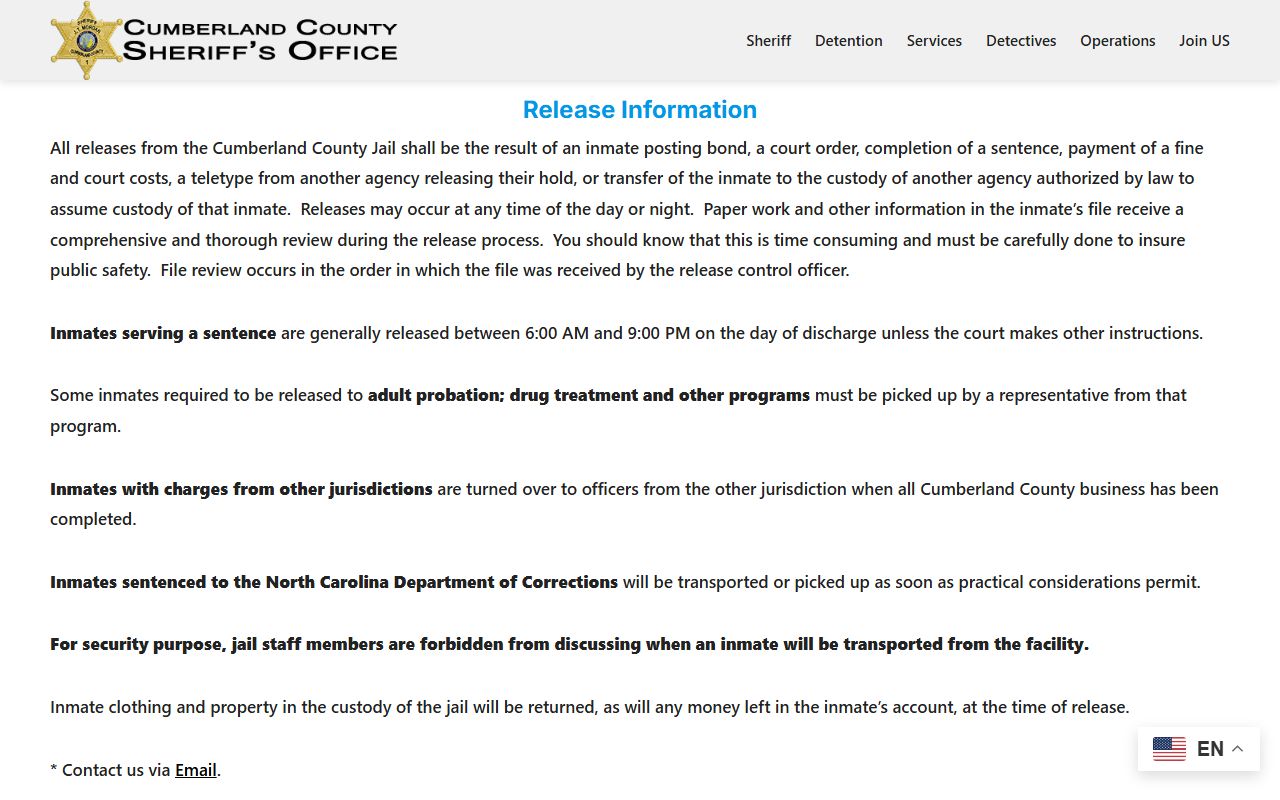
This page details release reasons, timing, the file review process, property return, and what happens when an inmate has holds from other jurisdictions.
Holds from other jurisdictions add another layer. If a person has charges pending in another county or state, Cumberland County completes its own business first and then turns the inmate over to that jurisdiction. If someone is sentenced to the NC Department of Corrections, they are transported or picked up as soon as practical. Jail staff will not discuss pending transport timing because it is a security matter, not a scheduling one.
- Bond
- Release after a judicial official sets a bond amount and it is posted in full or through a bondsman.
- Court Order
- A judge issues a written order requiring release, often tied to a case outcome or dismissal.
- Sentence Completion
- All jail time on the sentence has been served; sentenced inmates are generally released 6:00 AM to 9:00 PM on discharge day.
- Fine or Court Costs Paid
- The outstanding financial obligation that was the basis for confinement has been paid in full.
- Teletype / Hold Released
- Another agency sends a teletype message clearing the hold it had placed on the inmate.
- Transfer
- The inmate is moved to another lawful agency, such as a state prison transport or federal custody.
Note: releases occur at any hour, day or night, because bond can be posted, a court order issued, or a hold cleared at any time the relevant system processes it.