
How to Look Up Cumberland County Jail Population Data
The most current source for active custody in Cumberland County is the Sheriff's Active Inmate Lookup, which shows people currently held at the Cumberland County Detention Center. That roster reflects real-time bookings and releases. It is not an aggregate population report, but it is the only official public data source updated on a near-daily basis. The Sheriff's office also publishes a report center with incident reports and crime statistics, though population summary tables were not located in publicly accessible pages during research for this site.
For broader statistical context, the Bureau of Justice Statistics publishes the Annual Survey of Jails and the Census of Jails through bjs.ojp.gov. These national reports cover rated capacity, average daily population, and demographic breakdowns by county and by state. BJS data typically lags one to two years from the collection year. Researchers at the Prison Policy Initiative compile state-level and county-level incarceration rates using Census and BJS data. Neither source is updated daily, but both provide the national and state benchmarks needed to put any county jail number in context.
The screenshot below was captured from the Cumberland County Sheriff report center, which is the official online portal for publicly available Sheriff data.
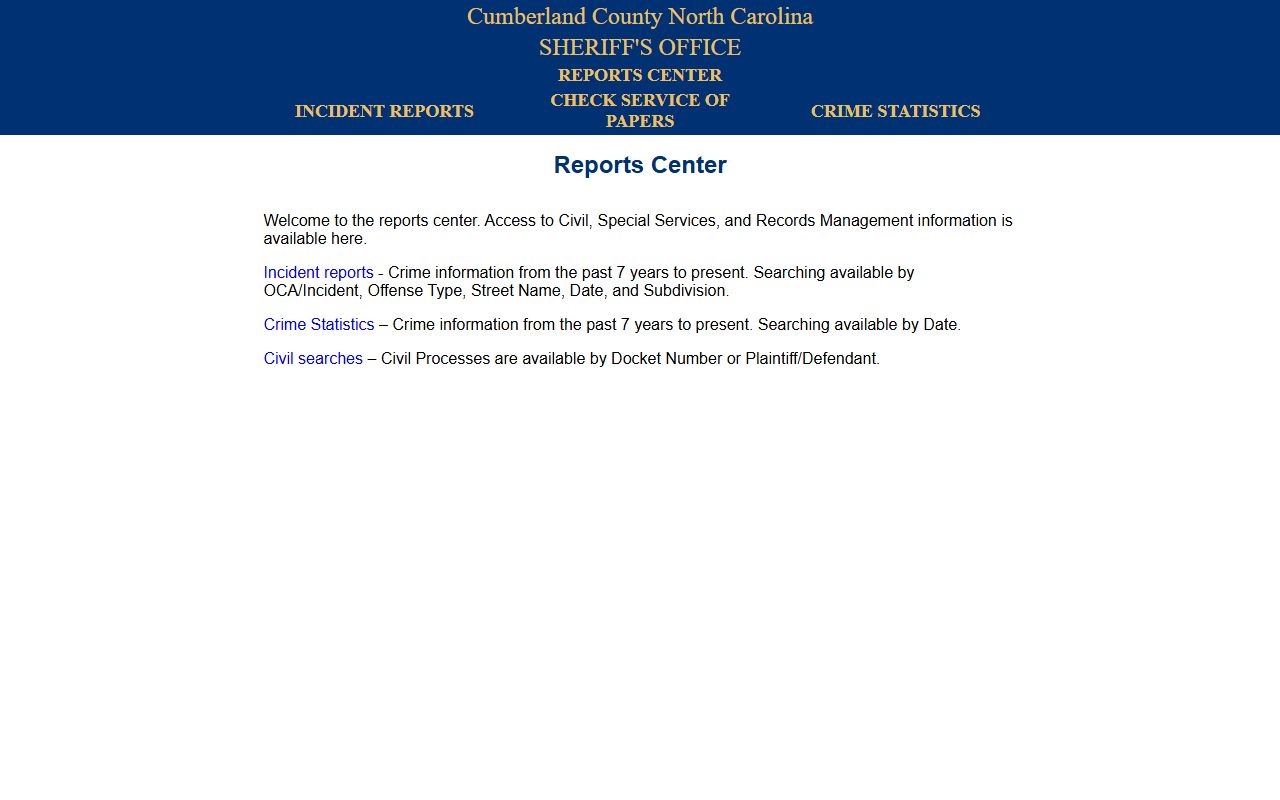
The report center links incident reports and crime statistics for Cumberland County; population-summary tables are not published here as of the most recent review.
If you are a researcher, journalist, or attorney who needs official capacity or population figures, the best starting points are the Cumberland County adopted annual budget (which may include detention staffing and jail bed counts under the Sheriff's department), the North Carolina Department of Health and Human Services jail inspection program reports, and BJS data requests. Budget documents can be requested from Cumberland County at the county public information office.
Cumberland County Jail Capacity Overview
The Cumberland County Detention Center is the single county jail facility operated by the Sheriff. It handles intake, booking, classification, housing, and release for people held on county charges. The facility is located near the Sheriff's headquarters at 131 Dick Street in Fayetteville. Jail operations are overseen by Chief Jailer Major Nichole Hoking and her command staff, who are responsible for security, booking and release functions, and inmate services.
Official rated capacity figures for the Cumberland County Detention Center were not published in accessible Sheriff or county web pages at the time this page was researched. The table below reflects what is known from official sources and notes what must be verified through budget or inspection documents. Do not rely on unofficial third-party websites for capacity numbers, as those figures are frequently inaccurate or out of date.
| Facility | Address | Rated Capacity | Info Desk |
|---|---|---|---|
| Cumberland County Detention Center | 131 Dick Street, Fayetteville, NC 28301 | Not published in official sources. Verify with Sheriff budget documents or NC jail inspection reports. | (910) 672-5630 / (910) 672-5622 |
Note: Official capacity figures should be confirmed through the Cumberland County adopted budget or a formal public records request before any publication or legal use.
Average Daily Population
Average daily population, or ADP, is the standard metric used to measure how full a county jail is over time. It is calculated by dividing the total number of person-days spent in jail over a year by 365. A jail with a high ADP relative to its rated capacity is operating near or above design limits, which affects staffing, programming, medical care, and safety conditions.
Cumberland County's ADP for the Detention Center was not located in publicly accessible Sheriff or county pages. BJS collects ADP figures through its jail surveys and publishes them by county in its data tables. To find the most recent official ADP for Cumberland County, check the BJS jail data tables at bjs.ojp.gov and search for Cumberland County, North Carolina. The Vera Institute of Justice also maintains county-level incarceration trend data at incarcerationtrends.vera.org, which can show whether ADP has risen or fallen over several years. If official figures have been published since this page was last updated, the Sheriff's annual report or the county budget narrative under the Detention Center program is the best local source.
For context: North Carolina as a whole has seen shifts in county jail population tied to bail reform discussions, COVID-era population reductions, and post-pandemic rebounds. Cumberland County's ADP may reflect those trends, but the county-specific figures must be pulled from official documents and cited with the year of data before they can be used reliably.
Demographic Breakdown
Demographic data for the Cumberland County jail population, including gender, race, and age distributions, was not located in publicly accessible Sheriff or county web pages during research. The Sheriff's active inmate search shows individual booking records but does not publish aggregate demographic tables. BJS jail surveys collect and report demographic data at the national and state level, and some of that data is broken out by county in the BJS data tools. Researchers seeking county-level demographic breakdowns should consult the BJS data tool at bjs.ojp.gov or submit a data request.
At the national level, BJS data from recent years shows that county jails hold a higher share of Black adults relative to their share of the general population. Male inmates make up roughly 85 percent of the national local jail population. Age distributions tend to cluster in the 25 to 44 range. North Carolina and Cumberland County may differ from national averages. The Prison Policy Initiative provides state-level demographic breakdowns using Census data, and their North Carolina profile is available at prisonpolicy.org. Those figures are state-level context, not Cumberland County-specific data.
The table below shows national reference points from BJS context. The Cumberland County column is blank because no official figure was located. These national averages are provided for orientation only and should not be read as Cumberland County figures.
| Demographic Group | National Local Jail Average (BJS context) | Cumberland County (official figure) |
|---|---|---|
| Male | Approximately 85% | Not published in official sources |
| Female | Approximately 15% | Not published in official sources |
| Ages 25-44 | Largest age cohort nationally | Not published in official sources |
| Race and ethnicity breakdown | See BJS Annual Survey of Jails | Not published in official sources |
To obtain demographic breakdowns for Cumberland County specifically, check the county adopted budget, request data from the Sheriff's Office under N.C.G.S. § 132-1 and § 132-6, or consult Vera Institute county data.
Pretrial vs. Sentenced Population
County jails hold two broad groups of people. Pretrial inmates are those who have not yet been convicted. They are awaiting a first appearance, bail hearing, trial, or other court proceeding. Sentenced inmates are serving a short jail sentence after conviction, usually for misdemeanors or low-level felonies where the sentence is under one year. In North Carolina, felony sentences of more than a year are generally served in state prison through the Department of Adult Correction, not in county jail.
The split between pretrial and sentenced inmates matters for several reasons. A jail with a large pretrial population may be incarcerating many people who have not been found guilty and who may be held because they cannot afford bail. North Carolina has active conversations about bail reform and pretrial detention, and Cumberland County courts reflect those state-level policy debates. The Cumberland County Pretrial Services program is one local mechanism that works within the court system to assess defendants before trial.
Official pretrial and sentenced breakdowns for the Cumberland County Detention Center were not located in accessible Sheriff or county pages. The table below shows the national context from BJS and notes that county-specific figures must be verified through official sources before use.
| Population Status | National Local Jail Average (BJS context) | Cumberland County (official figure) |
|---|---|---|
| Pretrial (unconvicted) | Approximately 65-70% nationally in recent BJS surveys | Not published in official sources |
| Sentenced (post-conviction) | Approximately 30-35% nationally | Not published in official sources |
For Cumberland County pretrial figures, check the BJS jail data tables or submit a data request to the Sheriff under the state public records law.
Misdemeanor vs. Felony Population
People held at the Cumberland County Detention Center may be there on misdemeanor charges, felony charges, or both. Misdemeanor defendants are usually held for shorter periods, often resolved through District Court. Felony defendants may be held for months while their case moves through preliminary hearings in District Court and then trial in Superior Court. Cumberland County is District 14 for both Superior Court and District Court purposes, meaning both court levels operate out of the same courthouse complex.
The booking process the Sheriff describes includes warrant checks and bail determination by a judicial official. Some people are released at intake after bail is set. Others stay held because bail was not granted or because they could not post the required amount. The charge type, whether misdemeanor or felony, affects the bail amount and often the length of detention before case resolution.
An official breakdown of the Cumberland County jail population by misdemeanor versus felony was not located in public Sheriff or county pages. BJS collects charge-type data in some survey cycles. The Prison Policy Initiative also publishes charge-type breakdowns at the state level, which provide context for how many people in North Carolina jails are held on nonviolent or low-level charges. Those are state-level numbers and should not be applied to Cumberland County without a county-specific source.
Mental Health and Medical Population
The Cumberland County Detention Center conducts medical screening and mental health screening as part of intake for every person booked into the facility. The Sheriff's detention page states that intake includes both screenings, along with identification checks, warrant checks, photograph, fingerprints, and bail determination. This process is designed to catch acute medical and mental health needs before a person is assigned to general housing. Not everyone who is screened will require ongoing treatment, but those with serious needs are identified early.
Mental health in county jails is a national concern. County jails often hold more people with untreated serious mental illness than state psychiatric hospitals. Cumberland County has invested in several problem-solving courts that address the intersection of mental illness and criminal justice involvement. The Mental Health Court provides an alternative track for defendants whose charges relate to a mental health condition. The Adult Drug Treatment Court serves defendants with substance use disorders. Both programs reduce time in the jail by routing eligible participants into supervised treatment rather than detention.
An official count of Cumberland County inmates receiving mental health or medical services was not located in public pages. BJS data from the Survey of Jails in Indian Country and related surveys suggest that a significant share of county jail inmates nationally have mental health needs. Cumberland County's figure is not publicly published. Researchers can request this data from the Sheriff under N.C.G.S. § 132-1 and § 132-6, or consult the county Mental Health Court program coordinator for referral trends.
Note: Mental health screening results are protected by N.C.G.S. § 122C-52 and are not part of the public jail record.
National and State Context
The Bureau of Justice Statistics tracks jail incarceration rates across the United States and publishes county-level data in its Annual Survey of Jails. At the national level, the local jail incarceration rate has ranged from roughly 220 to 240 per 100,000 residents in recent survey years, though this figure dropped sharply during the COVID-19 period and has been recovering since. North Carolina's statewide rate sits below the national average. The Prison Policy Initiative uses BJS and Census data to build state profiles, and their North Carolina analysis is one of the more accessible ways to compare state rates to the national picture.
The screenshot below comes from the Bureau of Justice Statistics website, the primary federal source for jail population data in the United States.
BJS publishes both annual survey estimates and full census data; the jail data page is the starting point for county-level research on incarceration rates.
The comparison table below shows the framework for placing Cumberland County in context. The county-specific figure is not published in official sources and must be calculated from verified official data before it can be used. The state and national figures reflect BJS survey context and should be verified against the most recent published BJS report.
| Level | Jail Population per 100,000 Residents | Source / Notes |
|---|---|---|
| Cumberland County, NC | Not published in official sources. Verify with Sheriff budget documents or BJS county-level data. | Request from Cumberland County Sheriff or pull from BJS county data tables. |
| North Carolina (state average) | Below the national average in recent BJS surveys; verify exact figure from current BJS publication. | Bureau of Justice Statistics |
| United States (national average) | Approximately 220-240 per 100,000 in recent pre-COVID survey years; verify from current BJS publication. | Bureau of Justice Statistics |
Cumberland County's population is roughly 335,000 residents. That base number can be used to estimate an incarceration rate once an official ADP figure is confirmed. Do not apply a rate from another county or a rounded estimate as a substitute for verified data.
Population Trends Over Time
County jail populations in North Carolina and across the country have moved through several distinct phases in the past decade. Populations rose through the mid-2010s in many counties, then dropped sharply when COVID-19 prompted emergency bail changes and court slowdowns in 2020. Since 2021, most county jails have seen gradual increases as courts cleared backlogs and normal booking patterns resumed. Whether Cumberland County follows this pattern closely or diverges from it depends on local court scheduling, the pace of case resolution in District 14, and Sheriff booking and release practices.
Multi-year trend data for the Cumberland County Detention Center was not located in publicly accessible Sheriff or county pages. Trend data is available through two paths. The BJS Census of Jails, conducted every five to seven years, captures a full count of every local jail in the country. Between census years, the BJS Annual Survey of Jails samples a portion of jails and publishes trend estimates. Vera Institute's Incarceration Trends tool at incarcerationtrends.vera.org pulls BJS survey data into a searchable county-level chart that shows population over time. Searching for Cumberland County, North Carolina in that tool is one of the faster ways to visualize multi-year trends without building a table from scratch.
The screenshot below comes from the Prison Policy Initiative, which publishes state and national incarceration trend analysis drawing on BJS data.
Prison Policy Initiative profiles provide trend context for North Carolina and for national patterns; their data is drawn from BJS surveys and the decennial Census.
If Cumberland County has experienced a significant population increase, that pressure may show up in the Sheriff's budget requests for additional detention staff or facility improvements. Budget documents submitted to the Cumberland County Board of Commissioners are public records under N.C.G.S. § 132-1 and may include population projections or bed-count justifications. Those are the most reliable local trend indicators short of an official annual report.
Searching for Cumberland County Inmate Records by Name
This page covers aggregate jail population data for the Cumberland County Detention Center. It does not include individual inmate lookup. For a name-based search of the live jail roster, use the Cumberland County inmate records page, which links directly to the Sheriff's Active Inmate Search and explains how the booking process affects when a new arrest appears in the system.
Where the Data Comes From
Population data for local jails comes from several official layers. At the local level, the Cumberland County Sheriff's Office is the primary source. The Sheriff operates the Detention Center and is the custodian of booking and release records under N.C.G.S. § 132-1.4. The Sheriff's active inmate search reflects current custody. Aggregate figures, if published, would appear in the Sheriff's annual report, the county adopted budget, or responses to public records requests filed under N.C.G.S. § 132-1 and § 132-6.
At the state level, North Carolina does not operate a centralized county jail population dashboard that is publicly accessible. NC jail inspection data exists within the state health department framework, but those inspection reports focus on physical conditions and compliance rather than daily population counts. The North Carolina Department of Adult Correction tracks state prison population, not county jail data.
At the federal level, the Bureau of Justice Statistics is the most authoritative source. BJS conducts the Annual Survey of Jails, which samples county jails and produces national and state-level estimates. BJS also conducts the full Census of Jails, which collects data from every jail in the country. Both are available through bjs.ojp.gov. The Vera Institute of Justice pulls BJS data into its Incarceration Trends tool and adds context from Census population figures. The Prison Policy Initiative also uses BJS and Census data to produce state profiles and national comparisons, available at prisonpolicy.org.
To contact the Sheriff's Office directly about population data or jail operations, use the contacts below.
Cumberland County Detention Center
131 Dick Street
Fayetteville, NC 28301
Info Desk: (910) 672-5630
Info Desk: (910) 672-5622
Chief Jailer
Major Nichole Hoking
Cumberland County Detention Center
(910) 672-5601
Sheriff Johnathan Morgan
Cumberland County Sheriff's Office
131 Dick Street
Fayetteville, NC 28301
(910) 323-1500
For public records requests related to jail population data, submit a written request to the Sheriff under N.C.G.S. § 132-1 and § 132-6. The county public information office at cumberlandcountync.gov is also a contact point for budget and departmental records.