
The Clerk as Probate Judge in Cumberland County
North Carolina does not separate probate from the general trial court the way some states do. There is no stand-alone probate court in Cumberland County. Instead, estate administration is handled through the courts, primarily in the office of the appropriate Clerk of Superior Court, unless the decedent set up alternatives to court-supervised administration. The elected Clerk of Superior Court is the record custodian for all court cases and, separately, acts as the ex officio judge of probate. That dual role means the same office that keeps your civil or criminal court file also opens and supervises estate proceedings.
This arrangement has a practical effect on how you search and how you file. Probate is not routed to a separate courthouse or a different building. Everything goes through the Clerk of Superior Court office at the Judge E. Maurice Braswell Cumberland County Courthouse in downtown Fayetteville. The Clerk reviews estate filings, determines what type of administration applies, and issues letters giving the personal representative legal authority to act. For most routine estates, the person handling the process will visit one office, use one phone number, and work with one set of AOC forms published by the North Carolina Judicial Branch.
Note: if the decedent set up a trust or other arrangement designed to avoid court supervision, the Clerk may have little or no role. Consulting an attorney before opening an estate is a good idea when assets are large, heirs are in dispute, or real property titles need clearing.
Probate Terms Used in Cumberland County Filings
Estate files use legal terms that can slow you down if you are not used to them. The definitions below cover the words you will see most in Cumberland County probate records and eCourts Portal results.
- Testator
- A person who made and signed a valid will before death. The testator's wishes, as written in the will, guide how the estate is distributed.
- Executor
- The person named in the will to carry out its instructions and settle the estate. Once the Clerk issues letters testamentary, the executor has legal authority to act on behalf of the estate.
- Administrator
- A person appointed by the Clerk to manage an estate when there is no will, when the named executor cannot serve, or when the will does not name one. Performs the same job as an executor but is court-appointed rather than named by the decedent.
- Intestate
- Dying without a valid will. North Carolina's intestate succession statutes then control who inherits. The Clerk appoints an administrator to handle the estate instead of following a will.
- Letters Testamentary
- The document the Clerk issues to an executor after the will is probated. It proves the executor has court authority to collect assets, pay debts, and make distributions. Banks and title companies will ask to see letters before releasing funds or transferring property.
- Guardianship
- A court-supervised arrangement where one person (the guardian) is given legal authority to care for a minor child or an adult who cannot manage personal decisions. Guardianship proceedings are filed with the Clerk as special proceedings.
- Conservatorship
- A court order giving one person authority to manage the financial affairs of another adult who is incapacitated. Like guardianship, a conservatorship proceeding is filed with the Clerk. The two are sometimes sought together when a person can neither make personal nor financial decisions.
Cumberland County Estate Record Types
The Clerk of Superior Court maintains several categories of probate and estate records. Each type represents a different stage of the estate process or a different kind of proceeding. Knowing which type you need will save time when you contact the office or search the Portal.
Wills filed for probate are the starting point for most testate estates. The original will is brought to the Clerk, reviewed for validity, and admitted to the court record. From there, an application for letters is filed and the Clerk determines what administration is needed. Once letters are issued, the estate enters the active administration phase, which generates its own set of documents.
- Wills - original documents filed and admitted to probate by the Clerk.
- Applications for letters testamentary or letters of administration - forms requesting that the Clerk appoint a personal representative.
- Letters testamentary / letters of administration - the issued authority documents that the personal representative presents to banks and other institutions.
- Inventories - a list of the decedent's assets filed by the personal representative after appointment.
- Accountings - periodic or final reports showing how estate assets were collected, what debts and costs were paid, and how the remainder was distributed.
- Receipts and distributions - signed acknowledgments from heirs or beneficiaries that they received their share.
- Estate orders - rulings the Clerk issues as part of the administration process.
- Guardianship and incompetency special proceedings - filed when an adult cannot manage personal or financial decisions and a court appointment is needed.
- Small estate / collection by affidavit - an alternative for qualifying small estates that bypasses full administration.
Each of these document types may appear in an eCourts Portal estate case summary. The Clerk's office has paper copies and can provide certified versions on request.
How to Search Cumberland County Probate Records
Probate records in Cumberland County are searchable through two main paths: the North Carolina eCourts Portal for online index searching, and the Clerk of Superior Court for official copies and any records not yet posted online. The Portal is free to use and does not require an account for public records.
The official NC Judicial Branch estates help page explains how estate administration runs through the Clerk and provides links to related forms and guidance. For the actual case index, the Portal is the primary online tool.
- Go to the North Carolina eCourts Portal and choose Smart Search.
- In the advanced filtering options, select the Estates filter to limit results to probate and estate case types.
- Enter the decedent's name, the estate case number if you have it, or an attorney name associated with the filing.
- Apply the Cumberland County location filter to narrow results to local filings.
- Open the case summary to view the Register of Actions, parties listed, estate events, hearing dates, and any filed documents available online.
- For certified copies of a will, letters, inventories, or accountings, contact the Clerk of Superior Court directly. The Portal is not the official court record; official copies come from the Clerk.
- For guardianship or incompetency special proceedings, use the Special Proceedings filter in Smart Search or the Judgment Search tool, which lists special proceedings as a case type category.
The screenshot below is from the official NC Judicial Branch wills and estates help page, which explains the Clerk's role and the steps for opening an estate in North Carolina.
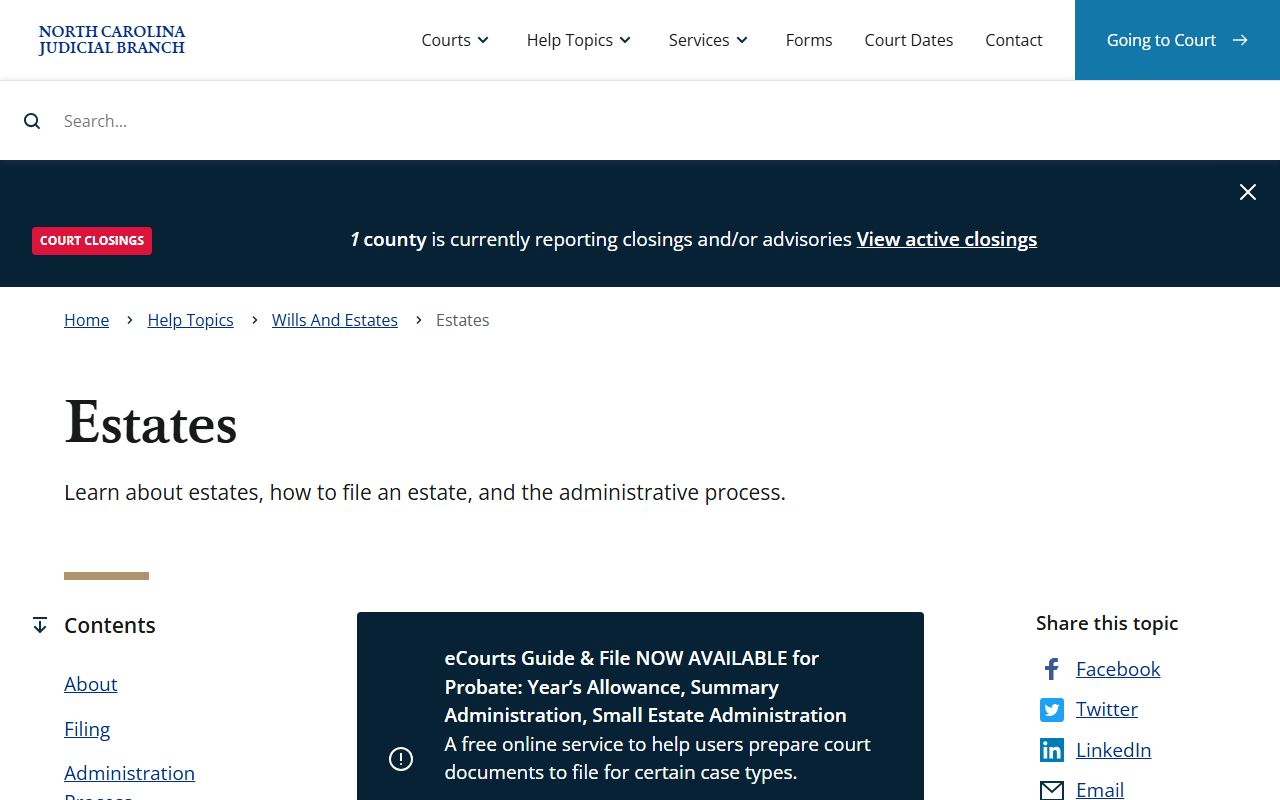
That page links directly to estate-related AOC forms and confirms that the Clerk of Superior Court handles estate administration for Cumberland County.
Clerk of Superior Court Estates Division
All Cumberland County probate filings and estate searches go through the Clerk of Superior Court office at the main courthouse in Fayetteville. The Clerk's office handles new estate openings, issues letters testamentary and letters of administration, reviews inventories and accountings, and provides certified copies of estate records. There is one probate contact point for Cumberland County, which makes the process straightforward compared to states where probate is routed to a separate building or a separate court.
Clerk of Superior Court - Estates
Judge E. Maurice Braswell Cumberland County Courthouse
117 Dick St.
Fayetteville, NC 28301
(910) 475-3000
Mon-Fri 8:00 AM - 5:00 PM
Mailing: PO Box 363, Fayetteville, NC 28302
Mail payments to the Clerk must be by money order or certified check, made payable to the Cumberland County Clerk of Superior Court. No cash and no personal checks are accepted by mail. In person, the Clerk accepts cash, credit or debit card with a processing fee, money order, or certified check. The official Cumberland County payment information page has the full payment rules.
Cumberland County Probate Filing Fees
Estate filing fees in North Carolina are set by state statute, not by the county. The controlling law is N.C. Gen. Stat. § 7A-308, which governs clerk fees in estates and special proceedings. The exact current amounts are published in the NC Judicial Branch court cost charts, which are updated when the legislature changes the fee schedule.
Because exact current fee amounts were not confirmed from the official court cost charts in this research pass, specific dollar figures are not listed here. Do not rely on third-party sources for probate fee amounts; they may be out of date. Use the official sources below to get current figures before filing.
| Item | Amount / Source |
|---|---|
| Estate administration filing fee | See NC Judicial Branch court cost charts |
| Letters testamentary / administration | See N.C.G.S. § 7A-308 and court cost charts |
| Guardianship / incompetency filing | See N.C.G.S. § 7A-308 |
| Certified copy of estate record (per page) | See current NC court cost charts |
| Small estate affidavit | See NC Judicial Branch court cost charts |
The screenshot below is from the official N.C. General Statutes § 7A-308 page on the NC General Assembly site, which lists the statutory fee framework for clerk services in estate and special proceeding matters.
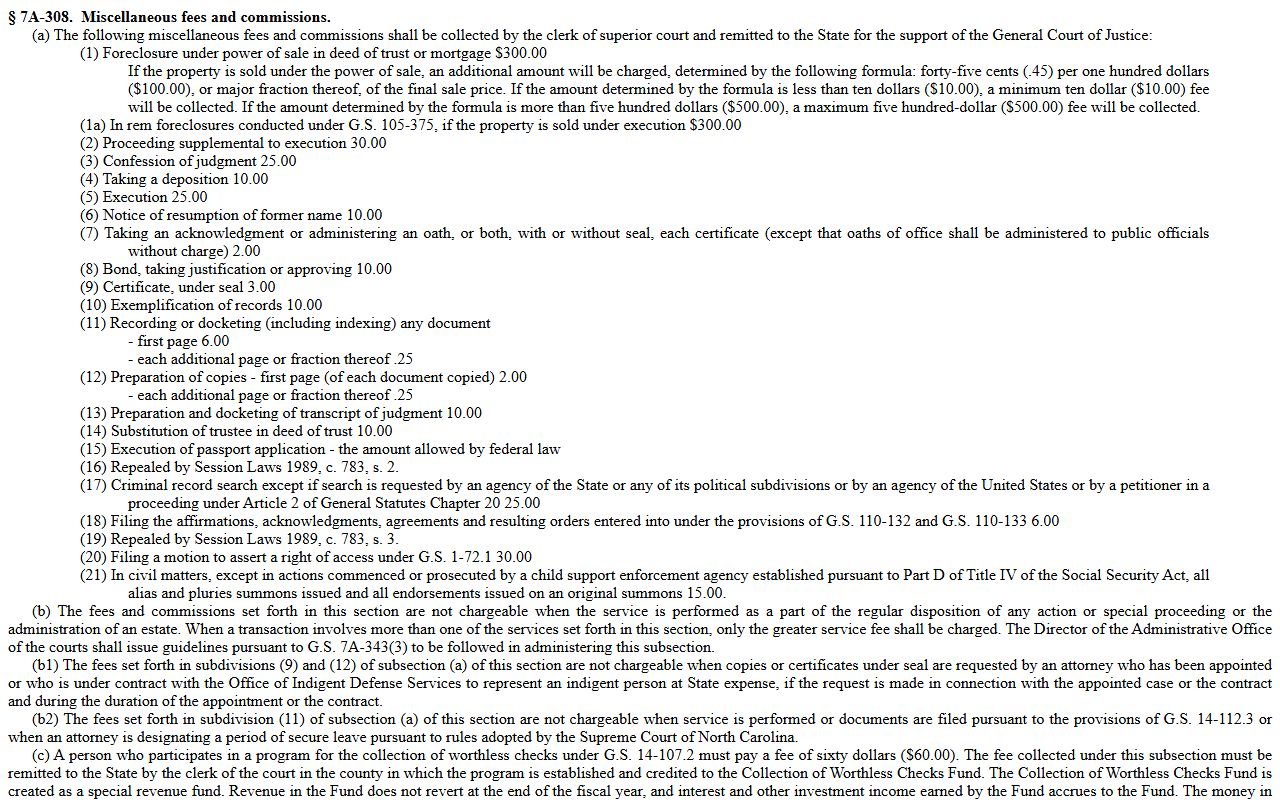
Section 7A-308 is the foundation for every fee the Clerk charges in a Cumberland County estate or special proceeding, and the current court cost charts on the NC Judicial Branch site translate those statutory provisions into the actual dollar amounts.
The Cumberland County Probate Process Step by Step
Opening an estate in Cumberland County follows a sequence set by North Carolina law. The steps below cover a standard administration through the Clerk of Superior Court. Complex estates, contested wills, or cases involving minors or incapacitated adults may require additional steps or attorney involvement.
- Determine domicile and property. Confirm that the decedent was domiciled in Cumberland County at death, or that Cumberland County property requires probate here. If the decedent lived in another county or state, the primary estate may need to open there first.
- Contact the Clerk of Superior Court estates division. Call (910) 475-3000 or visit the Clerk's office at 117 Dick St., Fayetteville, NC 28301 during business hours to ask which AOC forms you need and confirm the current requirements for the estate type.
- Gather required documents. Bring the original will if one exists, a certified death certificate, your own government-issued photo ID, contact information for all heirs and beneficiaries, a rough estimate of estate asset values, and the applicable AOC estate forms. The NC Judicial Branch publishes standard estate forms online.
- Clerk reviews the filing. The Clerk determines whether full administration, limited administration, or a small estate affidavit is appropriate. For testate estates, the Clerk examines the will for formal validity.
- Letters are issued. If a personal representative is appointed, the Clerk issues letters testamentary (executor named in a will) or letters of administration (no will or named executor). These letters give legal authority to act on behalf of the estate.
- Personal representative administers the estate. The representative gathers and secures assets, provides required notices to creditors and heirs, files an inventory of assets with the Clerk, pays valid debts and estate costs, and distributes remaining property to beneficiaries or heirs.
- File accountings and close the estate. The personal representative files the required accountings with the Clerk showing income, disbursements, and distributions. After the Clerk approves the final accounting and all required steps are complete, the estate closes.
The NC Judicial Branch estates help topic has additional guidance and links to the AOC forms used at each stage. For pro se filers, the NC Guide & File tool may also help with form preparation.
Guardianship and Special Proceedings in Cumberland County
Not every proceeding handled by the Clerk as probate judge involves a deceased person's estate. Guardianship and incompetency cases, sometimes called special proceedings, are filed with the Clerk when a living person can no longer manage their own affairs or care for themselves. These cases come up when an adult has a severe disability, dementia, or another condition that prevents independent decision-making.
To establish a guardianship or conservatorship, a petition is filed with the Clerk. The Clerk, acting as the ex officio judge of probate, reviews the petition and sets a hearing. Medical or clinical evidence is usually required to show the individual is incompetent. If the Clerk finds incompetency, a guardian of the person or a guardian of the estate, or both, may be appointed. The guardian must then file periodic reports or accountings with the Clerk to confirm the arrangement is working and funds are being managed properly.
Guardianship records are special proceeding case files and appear in the Portal under the Special Proceedings filter or the non-confidential special proceedings advanced filtering option in Smart Search. Some guardianship records may involve confidential health information and be restricted from public view. Contact the Clerk's office to ask about access to a specific guardianship file.
Note: guardianship of minors is a separate track from adult guardianship and may involve the court's juvenile or family division depending on the circumstances.
Restricted and Confidential Probate Records
Most estate records are court records and are generally open to the public under North Carolina law. A person can request a certified copy of a will or letters testamentary without showing a particular interest in the estate. That said, some related records are not open.
Adoption records are confidential under N.C. Gen. Stat. § 48-9-102, and any estate matter that overlaps with an adoption file is subject to those restrictions. Mental health and incompetency records may contain protected health information governed by N.C. Gen. Stat. § 122C-52. Juvenile guardianship proceedings intersecting with the court's juvenile jurisdiction are restricted under N.C. Gen. Stat. § 7B-3000. Social Security numbers are redacted and should not display on the Portal to any user, public or elevated.
Even within a public estate file, certain documents may contain personal identifiers that are redacted before public release. If you need a specific document and are unsure whether it is restricted, call the Clerk at (910) 475-3000 before making a trip to the courthouse.