
North Carolina Public Records Law
North Carolina's public records framework lives in N.C.G.S. Chapter 132. The core statute, Section 132-1, defines a public record broadly as any documentary material made or received by a state or local agency in connection with public business. That covers paper, digital files, photographs, recordings, and nearly any other medium. The statute says public records are the property of the people and should be available free or at minimal cost unless another law says otherwise.
Anyone can request public records in North Carolina. There is no residency requirement. You do not have to give a reason for your request. An agency custodian must allow inspection of records during regular business hours, and it must provide copies when asked. Section 132-6 sets out the inspection and copying framework. An agency that denies a request must point to a specific exemption in law. If it cannot, the records must be released.
The image below comes from the official NC General Assembly page for N.C.G.S. § 132-1, the foundational public records definition and policy statute.
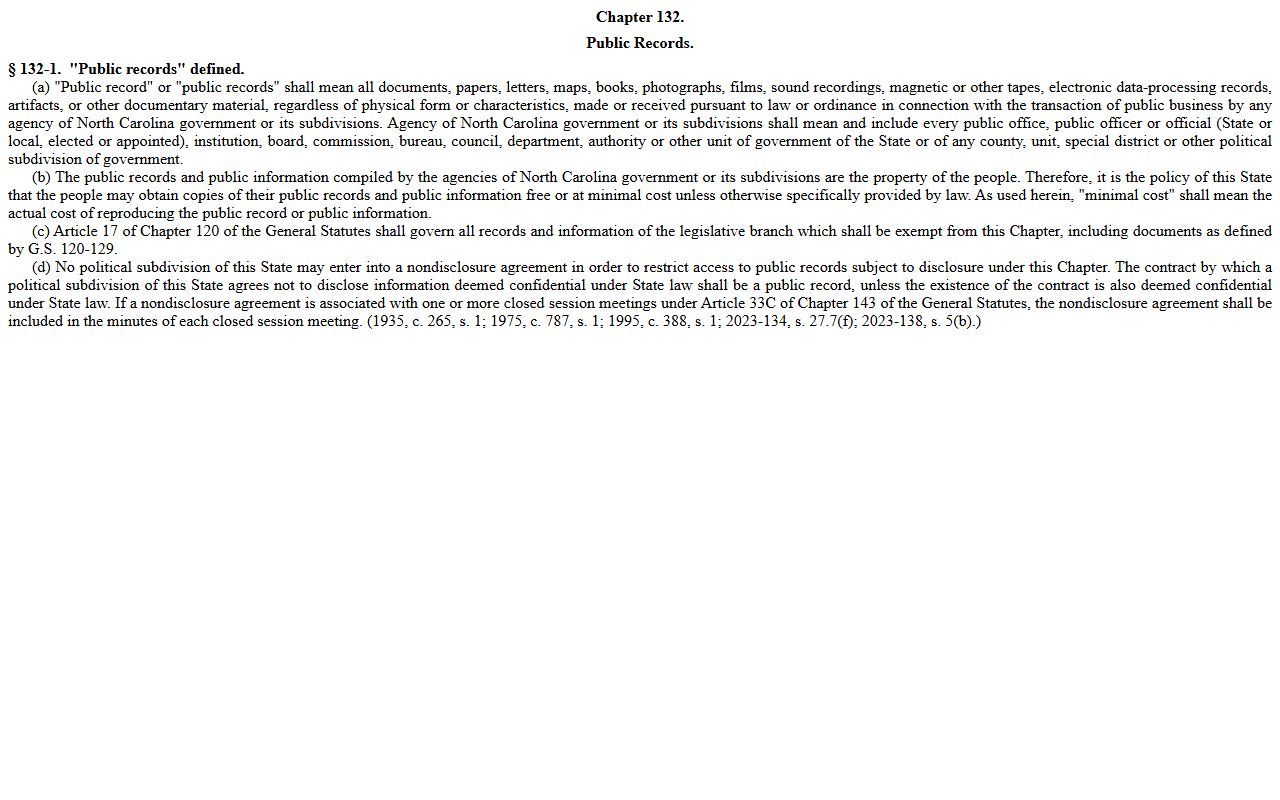
Section 132-1 is the starting point for any Cumberland County public records request that falls outside the court system.
- N.C.G.S. § 132-1: Defines public records; states they are the people's property and available free or at minimal cost.
- N.C.G.S. § 132-6: Governs inspection and copying; agencies must allow review during business hours and provide copies.
- N.C.G.S. § 132-1.4: Criminal investigation and intelligence records are not open in the same way as ordinary administrative records; some Sheriff data falls under this exemption.
- N.C.G.S. § 7A-109: Clerk of Superior Court record-keeping duties; underpins public indexing of court records.
- N.C.G.S. § 7A-109.2: Authorizes remote electronic access to court records; the legal basis for the eCourts Portal.
Court Records vs. County Administrative Records
Not all Cumberland County public records come from the same place. Court records and county administrative records are two different systems. They follow overlapping but distinct legal frameworks, and you reach them through different offices.
Court records sit with the Clerk of Superior Court under Chapter 7A of the General Statutes. They include every filing made in a civil, criminal, family, probate, or special proceeding case heard in Cumberland County. The public can search them through the North Carolina eCourts Portal. That Portal is not the official record, but it shows case summaries, hearing dates, dispositions, and judgment information for most public cases. For an official or certified copy, you contact the Clerk of Superior Court at 117 Dick St., Fayetteville, NC 28301, phone (910) 475-3000. For a deeper look at court filings, visit the court records page.
County administrative records are documents made by county government departments during their normal work. These include contracts, budgets, meeting minutes, building permits, personnel policies, and similar files. Requests for those records typically go to the relevant department or to the county's public information office. Cumberland County's Public Information page is the starting point for county administrative record requests.
The screenshot below is from the official NC General Assembly page for N.C.G.S. § 132-6, which governs how the public inspects and copies records held by government agencies.
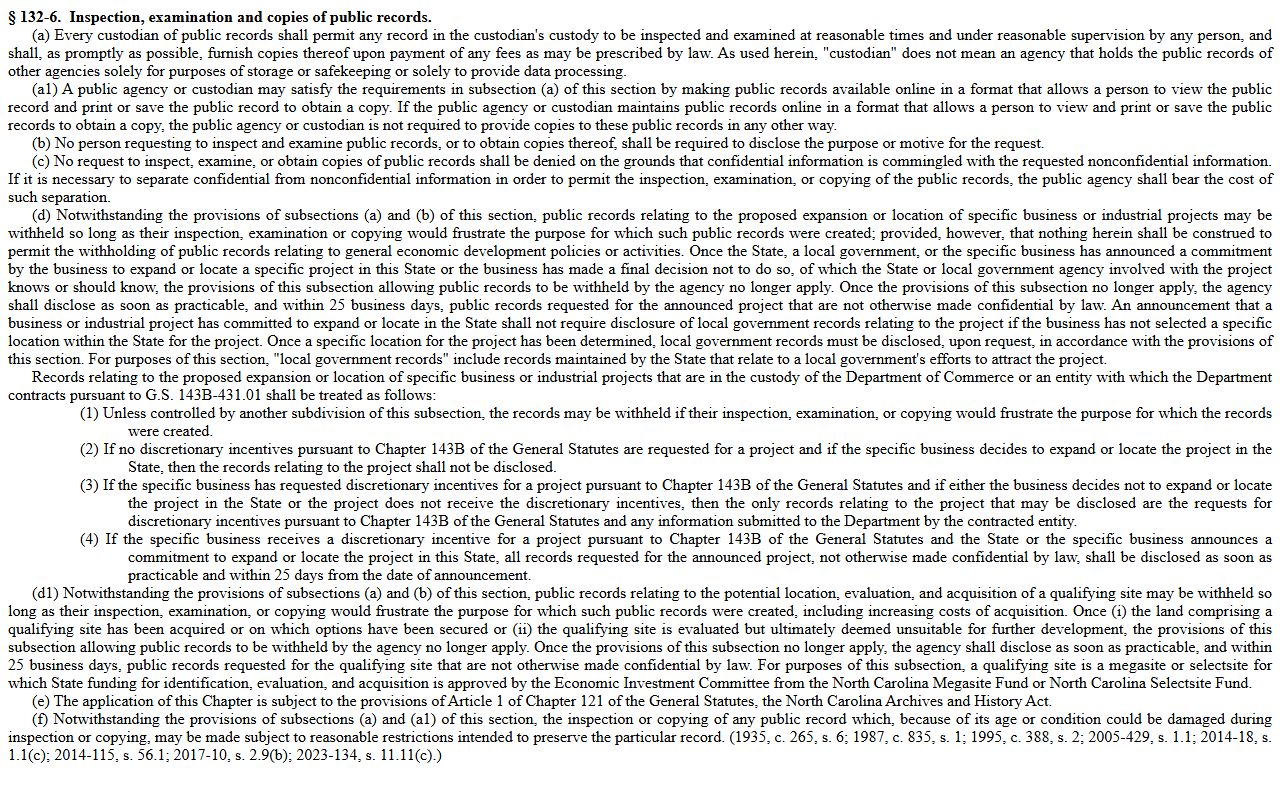
Section 132-6 gives requesters the right to inspect records during business hours and to get copies, with the agency setting a reasonable copy fee.
Register of Deeds Records in Cumberland County
The Cumberland County Register of Deeds is a separate elected office from the Clerk of Superior Court. It is led by Andra S. Brewington and sits in Room 114 of the Judge E. Maurice Braswell Cumberland County Courthouse, 117 Dick Street, Fayetteville, NC 28301. General phone is 910-678-7775; Vital Records line is 910-678-7795; Land Records line is 910-678-7773. The Register's official site is ccrod.org.
Land records in this office date back to 1754, when Cumberland County was formed. That makes the Register one of the oldest continuing public record repositories in the county. The office records deeds, deeds of trust and mortgages, liens, plats, assumed business names, notary oaths, and similar instruments. It also records military discharges (DD-214 forms) free of charge for retired military, which reflects the county's close ties to Fort Liberty and the Fayetteville military community.
On the vital records side, the Register holds birth, death, and marriage records. Certified copies of these documents require valid identification and, for some records, proof of relationship. You can search land records and a limited vital-record index through the Register's online portal at ccrodinternet.org, and you can start a marriage license application at ccrodmarriage.org before appearing in person. For fees and the request form for birth, death, and marriage records, see the Register of Deeds vital-record fee schedule.
The following screenshot is from the official Cumberland County Public Information page, which handles open records requests for county administrative departments.
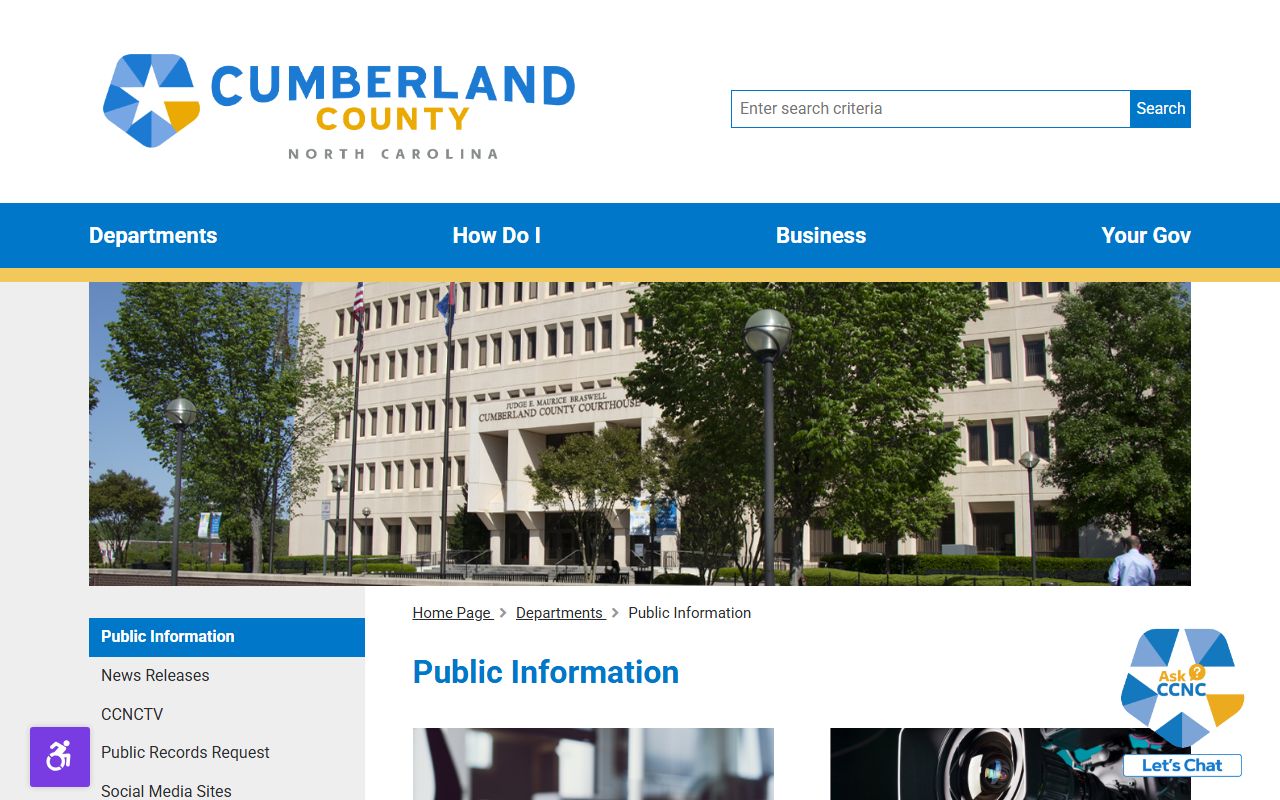
County administrative records requests not handled by the court or the Register of Deeds go through this page.
| Record Type | Office | Fee / Note |
|---|---|---|
| Marriage license | Register of Deeds | $60.00 |
| Marriage certified copy | Register of Deeds | $10.00 in person/mail; $14.50 online |
| Birth certified copy | Register of Deeds | $10.00 |
| Death certified copy | Register of Deeds | $10.00 |
| Land deed recording (first 15 pages) | Register of Deeds | $26.00 |
| Deed of trust (first 35 pages) | Register of Deeds | $64.00 |
| DD-214 military discharge recording | Register of Deeds | No fee where authorized |
| Uncertified copies (land or vital) | Register of Deeds | $0.25 per page |
| Court copy or certified court record | Clerk of Superior Court | Contact Clerk; see NC court cost charts |
| General administrative records copies | Relevant county department | Free or at minimal cost per § 132-1; custodian sets copy fee |
Sheriff Incident Reports and Law Enforcement Records
The Cumberland County Sheriff's Office maintains its own records through the Records Management unit. The official page is at cumberlandsheriffnc.gov/records-management/. From that page you can access incident reports and crime statistics through the Sheriff's report center. The Sheriff also enters warrants and orders for arrest into the local PISTOL records management system and into the DCI/NCIC databases for eligible felony and serious misdemeanor warrants.
Law enforcement records occupy a different legal space than ordinary county administrative records. N.C.G.S. § 132-1.4 controls criminal investigation and criminal intelligence information. The Sheriff's active inmate search page states explicitly that information is provided under this statute and that information not subject to disclosure is not available through the site. Some records can only be released by court order.
The image below is taken from the official NC General Assembly page for N.C.G.S. § 132-1.4, the statute that governs criminal investigation records held by law enforcement.
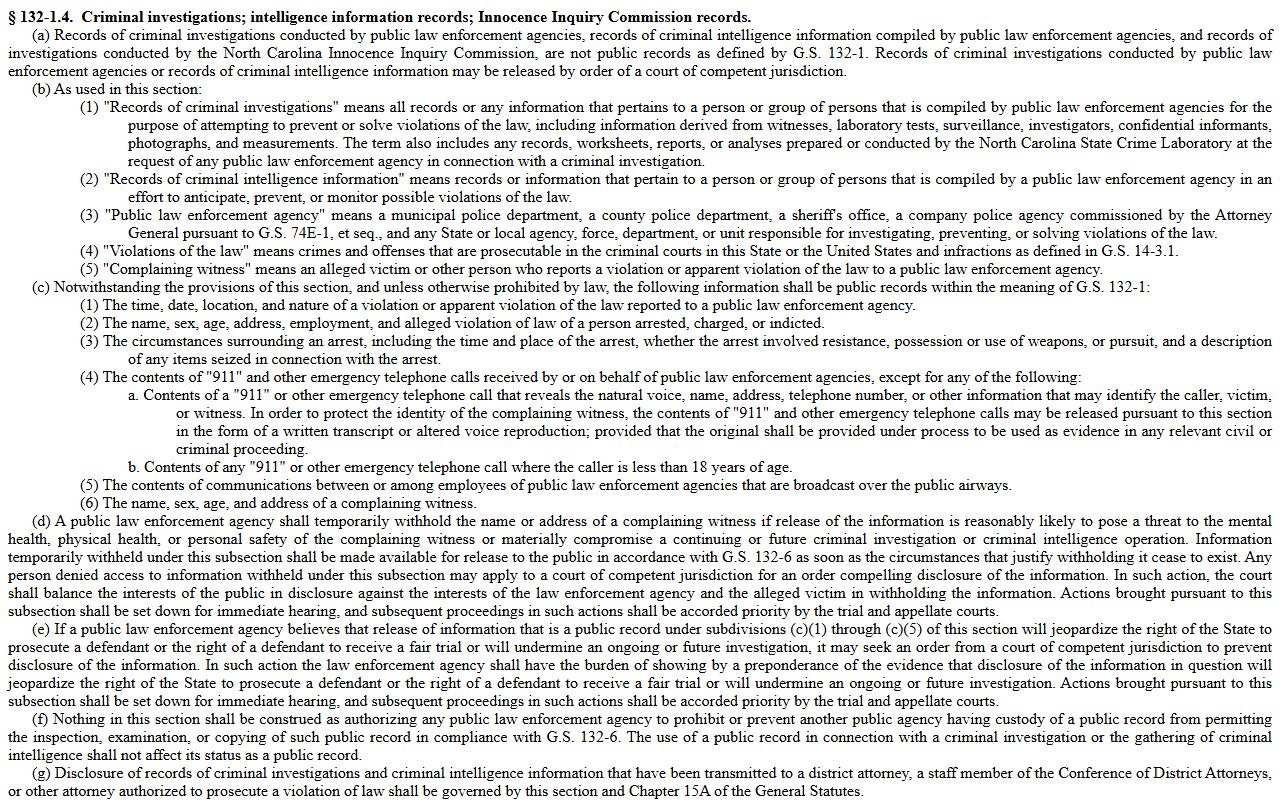
This statute creates a separate access framework for criminal investigative records, which is why some Sheriff data requires a court order rather than a simple public records request.
One important limit: accident reports completed by the Cumberland County Sheriff are not available online. The official Records Management page says accident reports should be requested by phone or email, and the active inmate notice points requesters to NCDMV as an alternate source. For criminal arrest records, both the eCourts Portal and the Sheriff's report center are relevant depending on what stage the matter is at. For matters that became court cases, the Clerk's records are the better source.
How to File a Public Records Request in Cumberland County
Filing a public records request in Cumberland County is simpler than many people expect. North Carolina law does not require a formal form or a written request for most records. An oral request is valid. That said, a written request creates a paper trail and gives the agency a clear description of what you need. The steps below apply to county administrative and Sheriff records. Court records and Register of Deeds records have their own processes covered elsewhere on the site.
- Identify the record and its custodian. Decide which office holds the file. County department records go to that department or to the Cumberland County Public Information office. Sheriff reports go to Sheriff Records Management. Court records go to the Clerk of Superior Court. Register of Deeds records go to the Register of Deeds.
- Describe the records clearly. Give enough detail to help the custodian find the file. Include names, dates, case or permit numbers, and any other identifiers you have. A vague request may take longer to fulfill.
- Submit your request. You do not have to state a purpose under North Carolina law. Submit in person during office hours, by mail, or by email. The county's Public Information page includes a records request link for county administrative departments.
- Wait for the agency response. Chapter 132 does not set a single numeric deadline for all requests, but agencies must respond within a reasonable time. If a request is large or involves review for exemptions, the agency may need more time. Follow up if you hear nothing after a week or two.
- Pay any copy costs and receive the records. Most public records are available free or at minimal cost. If you want paper copies, the agency may charge a per-page fee. Electronic copies, where available, may carry no additional cost. Confirm the fee before the agency begins copying so there are no surprises.
For court records specifically, visit the Clerk of Superior Court at 117 Dick St., Fayetteville, NC 28301, call (910) 475-3000, or search online through the North Carolina eCourts Portal. The Portal lets you view most public case summaries at no charge. Certified copies require a visit to or mail request to the Clerk. For more on court-specific access, see the Clerk of Superior Court page.
What the Clerk of Superior Court Maintains
The Clerk of Superior Court is the primary court record custodian in Cumberland County. The office sits in the Judge E. Maurice Braswell Cumberland County Courthouse at 117 Dick St., Fayetteville. Beyond filing and storage, the Clerk also functions as the probate judge for estate matters. That means one office handles both everyday court filings and the opening of wills and estate administrations.
The screenshot below is from the official NC General Assembly page for N.C.G.S. § 7A-109, the statute that sets out clerk record-keeping duties and underpins public indexing of court records.
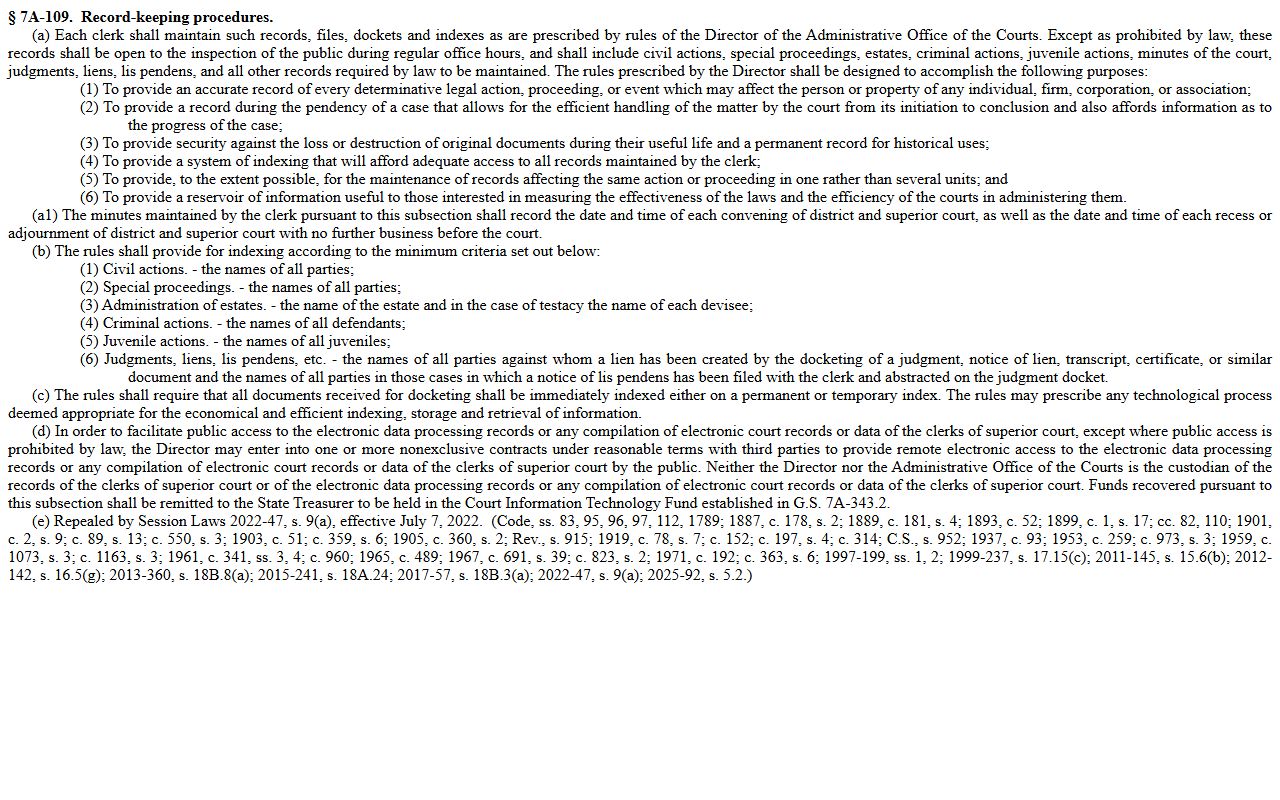
Section 7A-109 requires the Clerk to maintain a complete, indexed record of all proceedings, which forms the legal basis for the public access that the eCourts Portal provides.
Court records the Clerk maintains include:
- Civil case files (complaints, orders, judgments, civil calendars)
- Criminal case files (charges, dispositions, fines, financial obligations)
- Family court records (divorce, custody, support, equitable distribution)
- Probate and estate files (wills, letters, inventories, accountings, guardianship)
- Special proceedings (foreclosures, partitions, incompetency hearings)
- Traffic and infraction records
Court payments by mail go to Clerk of Superior Court, Cumberland County Courthouse, PO Box 363, Fayetteville, NC 28302. Payments must be money order or certified check; no cash or personal checks by mail. In-person payments accept cash, credit or debit cards (with processing fees), money order, or certified check. For a complete picture of what the Clerk does and how to get certified copies, see the Clerk of Superior Court page.
Remote Electronic Access to Cumberland County Court Records
North Carolina authorized remote electronic access to court records through N.C.G.S. § 7A-109.2. That statute is the legal basis for the eCourts Portal, which the NC Judicial Branch launched across counties in recent years. Cumberland County joined the eCourts rollout, and the county's Judicial Branch page links directly to the Portal for search and pay functions.
The screenshot below is from the official NC General Assembly page for N.C.G.S. § 7A-109.2, which sets the statutory framework for remote access to court records in North Carolina.
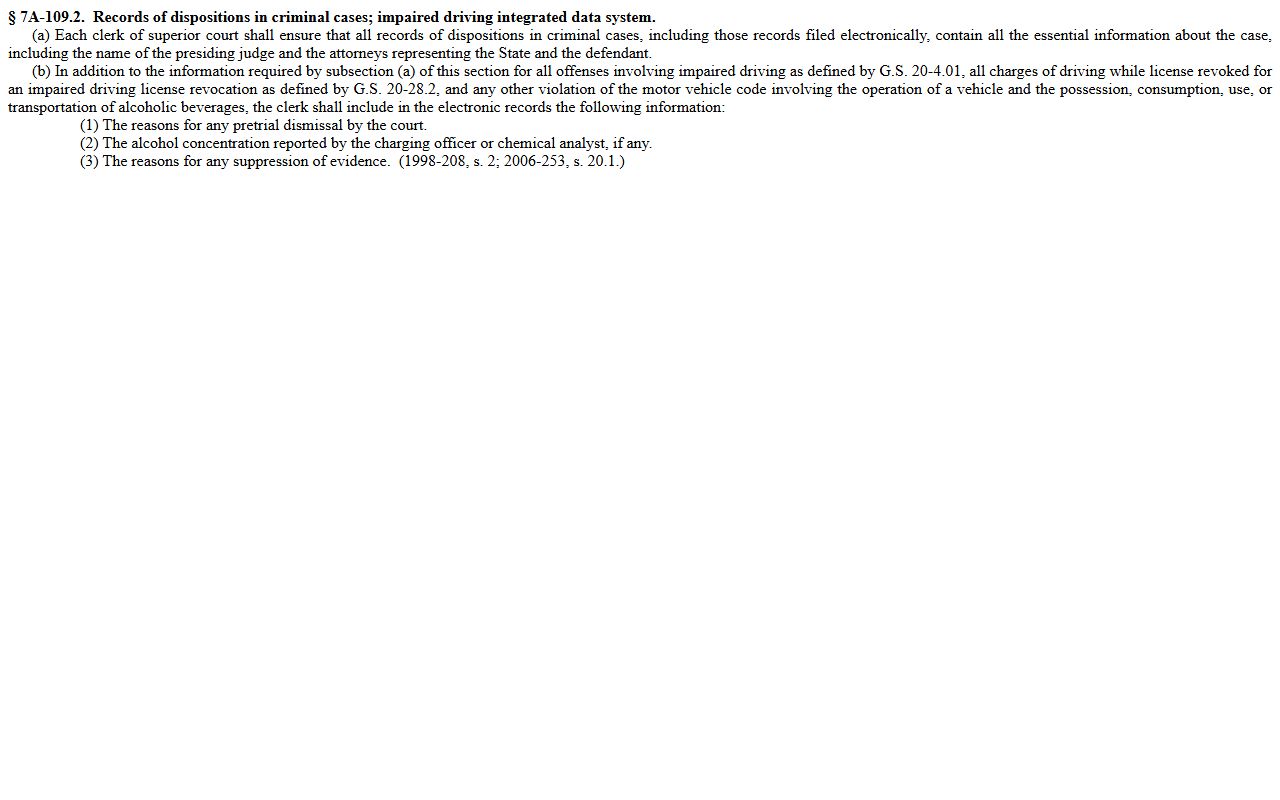
Section 7A-109.2 gives the NC Judicial Branch authority to provide electronic access and sets boundaries on what information can be made available remotely.
The eCourts Portal gives the public free access to case summaries, hearing schedules, and judgment indexes without creating an account. Registration lets you save cases to "My Cases." Some record types require elevated access, meaning you must register and show a verified business need or statutory authority. The Portal is not the official court record. If you need an official or certified copy, you must contact the Clerk of Superior Court directly. In June 2025, the NC Judicial Branch deployed eCourts kiosks inside Cumberland County's courthouse, adding on-site terminals with scanners, printers, and payment services for people who prefer not to use the web portal from home.
Confidential and Restricted Records
Not every record held by a Cumberland County office is open to the public. North Carolina law restricts several categories, and an agency that receives a request for a restricted record must deny access or redact the protected portions before releasing the rest. Understanding what is off-limits helps you avoid a fruitless request and points you toward what you can actually get.
| Record Category | Authority | Access Rule |
|---|---|---|
| Juvenile court records | N.C.G.S. § 7B-3000 | Restricted; requires statutory authority, attorney role, or court order |
| Adoption records | N.C.G.S. § 48-9-102 | Confidential; public access generally barred without legal authority |
| Mental health and substance abuse records | N.C.G.S. § 122C-52 | Confidential client records; not available through a standard public records request |
| Expunged records | N.C.G.S. § 15A-151 | Removed from public access after expunction; confidential files retained for limited official use only |
| Sealed records | Court order / rule | Blocked in Portal; requires court order or specific authority to access |
| Unreturned criminal warrants | Portal FAQ / § 7A-109.2 | Restricted in eCourts Portal; requires elevated access |
| Protective orders | Portal FAQ | Restricted in Portal; may be accessible through courthouse kiosk under different rules |
| Criminal investigation and intelligence records | N.C.G.S. § 132-1.4 | Not subject to general public records access; some require court order |
| Social Security numbers | Portal FAQ / privacy law | Should not display in Portal to public or elevated access users |
Accident reports are a common access question. The Cumberland County Sheriff's Records Management page says accident reports completed by the Sheriff are not available online right now. They can be requested by phone or email through the Records Management office. The official inmate search notice also says accident reports may be obtained through NCDMV for accidents investigated by the Sheriff's Office. If you need a report from a city police agency, contact that agency directly.
If you believe a record was withheld without proper legal basis, you can seek review. The NC Attorney General's office has published guidance on public records disputes. A person whose request is denied may also file a civil suit in Superior Court under Chapter 132 to compel disclosure. For records that touch court filings, consulting an attorney is advisable before challenging a denial. For information on related sealed and expunged records in the criminal context, see the criminal records page.
Vital Records and Access Restrictions
Vital records in Cumberland County include birth certificates, death certificates, and marriage records. The Register of Deeds holds the local copies; the North Carolina Vital Records office in Raleigh holds the statewide copies. Either source can provide a certified copy, but the process and fee may differ. The Register of Deeds birth, death, and marriage request form is available on the Register's site.
Birth and death certificates are not fully open records. North Carolina restricts certified copies of these documents to the registrant or to specific authorized relatives and legal representatives. You must present valid identification when requesting a certified copy in person or by mail. Accepted IDs include an unexpired driver's license, state ID, passport, or military ID. If your ID is expired, you must bring three supporting documents that show your printed name. For marriage records, the same ID rules apply. Uncertified copies of some vital records are available to the public at a nominal per-page fee and are useful for genealogy or general reference where legal certification is not needed.
Divorce records are court files, not vital records. The Register of Deeds does not hold them. Divorce case files sit with the Clerk of Superior Court through the District Court family division. Certified divorce certificates can be ordered from NC Vital Records, but the case file itself is a court record. For more on finding divorce and marriage filings, see the marriage and divorce records page.
Public Records Request Contacts in Cumberland County
Routing your request to the right office saves time. Each office below handles a distinct set of records. Going to the wrong place will only delay things.
Judge E. Maurice Braswell Cumberland County Courthouse
117 Dick St., Fayetteville, NC 28301
Mailing: PO Box 363, Fayetteville, NC 28302
Phone: (910) 475-3000
Hours: Monday-Friday 8:00 AM - 5:00 PM
Records: civil, criminal, family, probate, traffic, and special proceeding court files
117 Dick Street, Room 114, Fayetteville, NC 28301
General: 910-678-7775 | Vital Records: 910-678-7795 | Land Records: 910-678-7773
Online portal: ccrod.org
Records: land records from 1754, birth/death/marriage, DD-214 military discharges, notary oaths, assumed names
Cumberland County Sheriff's Office, 131 Dick Street, Fayetteville, NC 28301
Records page: cumberlandsheriffnc.gov/records-management/
Records: incident reports, crime statistics, accident reports (by phone/email only)
Request page: co.cumberland.nc.us public information
Records: county administrative and department records not handled by the court, Register, or Sheriff
For federal court records, visit PACER for the U.S. District Court and U.S. Bankruptcy Court for the Eastern District of North Carolina. PACER requires an account; per-page fees and quarterly exemptions apply. The Fayetteville federal courthouse is at 301 Green Street, Fayetteville, NC 28302, phone (910) 483-0550.