
Cumberland County Clerk of Superior Court Office
The Clerk of Superior Court is an elected office in North Carolina. The clerk serves the entire county and is responsible for all court filings, official case records, certified copies, court fee collection, and estate administration. Under North Carolina law, the Clerk also acts as the ex officio judge of probate, meaning this single office handles both day-to-day record keeping and the formal probate and estate process. That dual role makes the Clerk the most important local court office for anyone dealing with civil, criminal, family, or estate matters in Cumberland County.
The office sits inside the Judge E. Maurice Braswell Cumberland County Courthouse in downtown Fayetteville. The main courthouse telephone connects directly to the Clerk. Court payment mail goes to a separate post office box, not the physical address. Hours are standard business days, Monday through Friday.
The official Cumberland County court contact directory lists the Clerk of Superior Court alongside Superior Court judges, District Court judges, the District Attorney, magistrates, and family court staff.
Clerk of Superior Court
Judge E. Maurice Braswell Cumberland County Courthouse
117 Dick St.
Fayetteville, NC 28301
(910) 475-3000
Mon-Fri 8:00 AM - 5:00 PM
Court Payment Mailing:
PO Box 363
Fayetteville, NC 28302
Note: Use the PO Box only for mailing court payments. Use the Dick Street address for in-person visits and certified mail requiring a physical delivery address.
What the Clerk Does in Cumberland County
North Carolina clerks carry more responsibilities than clerks in many other states. The role blends record keeping, judicial functions, and financial management. The clerk receives every court filing, assigns case numbers, maintains the register of actions, collects fines and court costs, and issues process such as summonses and subpoenas. The clerk also runs the estate and probate process as a judicial officer, not just as a record keeper.
The statutory framework comes from several places. N.C. Gen. Stat. § 7A-109 sets out clerk record-keeping duties and underpins the public indexing system. N.C. Gen. Stat. § 7A-109.2 addresses remote electronic access to court records, which is the legal basis for eCourts Portal access. N.C. Gen. Stat. § 7A-308 governs clerk fees for estates and special proceedings. Together these statutes define the Clerk's daily work and set the fee structure the office uses.
- Receive, docket, and index all civil, criminal, family, probate, and special proceeding filings.
- Maintain official case records and the register of actions for Superior Court and District Court.
- Issue certified copies of court documents upon request and payment.
- Collect court costs, fines, fees, and restitution and process eligible online and in-person payments.
- Administer estates and probate proceedings as the ex officio judge of probate under state law.
- Process expunction orders and maintain confidential files as required by statute.
- Issue summonses, subpoenas, and other court process.
The NC Judicial Branch court officials page describes the statewide role of clerks and how their authority fits the broader unified court structure.
How to Request a Certified Copy in Cumberland County
Certified copies are the official version of a court record. A plain printout from the eCourts Portal is not certified and is not accepted in legal proceedings, loan applications, immigration filings, or other formal contexts. A certified copy carries the clerk's seal and signature and confirms the document is a true copy of the original file. Anyone who needs proof of a court order, a divorce judgment, an estate letter, or a criminal disposition for an official purpose must get a certified copy from the Clerk of Superior Court.
The process is straightforward. It starts with identifying the case and ends with payment. In-person requests are the fastest. Mail requests work but take longer and require a money order or certified check.
- Identify the case. Gather the case number if you have it. If not, note the full names of the parties and the approximate filing year. A case number makes the search exact and faster.
- Contact or visit the Clerk's office. Call (910) 475-3000 or go to 117 Dick St., Fayetteville, NC 28301, Monday through Friday, 8:00 AM to 5:00 PM. Staff can confirm whether the record exists and what fees apply.
- Provide the required information. Give the clerk the case number or party names, the document type you need, and the number of copies. For estate records, you may also need your relationship to the decedent or written authorization.
- Pay by an accepted method. In person, pay by cash, credit or debit card (processing fee applies), money order, or certified check. No personal checks in person. By mail, send a money order or certified check only, made payable to Cumberland County Clerk of Superior Court, to PO Box 363, Fayetteville, NC 28302. Include the case number and a return address.
- Receive the certified copy. In-person requests are often filled the same day for standard files. Mail requests take additional time for processing and postage. Certified copies needed for court proceedings are generally required before your next hearing date, so request early.
Important: Certified copies are required for legal proceedings, loan closings, immigration filings, and other formal uses. Uncertified online copies from the eCourts Portal are not accepted in court or by most government agencies as official records.
Records Request Information to Provide
The Clerk's office does not use a single statewide online submission form for all certified-copy requests. Requests are handled in person or by mail. When you contact the office, have these details ready. Providing complete information reduces delays and helps staff locate the correct file quickly.
| Field / Item | Required | Notes |
|---|---|---|
| Case Number | Strongly recommended | Best identifier; use if available from the eCourts Portal or prior correspondence. |
| Party Names | Yes, if no case number | Provide full legal names for plaintiff/defendant or petitioner/respondent. |
| Approximate Filing Year | Helpful | Narrows search when case number is unknown. |
| Document Type | Yes | Specify: certified copy of judgment, divorce decree, estate letters, court order, etc. |
| Number of Copies | Yes | State how many certified copies you need; fees apply per copy. |
| Requester Name and Return Address | Yes for mail requests | Staff must know where to send documents and who is requesting them. |
| Payment | Yes | In person: cash, card (fee), money order, certified check. By mail: money order or certified check payable to Cumberland County Clerk of Superior Court. |
The NC Judicial Branch publishes standard AOC forms used in North Carolina courts. Many are available on the NC courts forms page. Local Cumberland County forms, including family court and juvenile forms, are listed on the Cumberland County local rules and forms page.
The screenshot below comes from the official NC Judicial Branch forms library, where statewide AOC forms are posted for download.
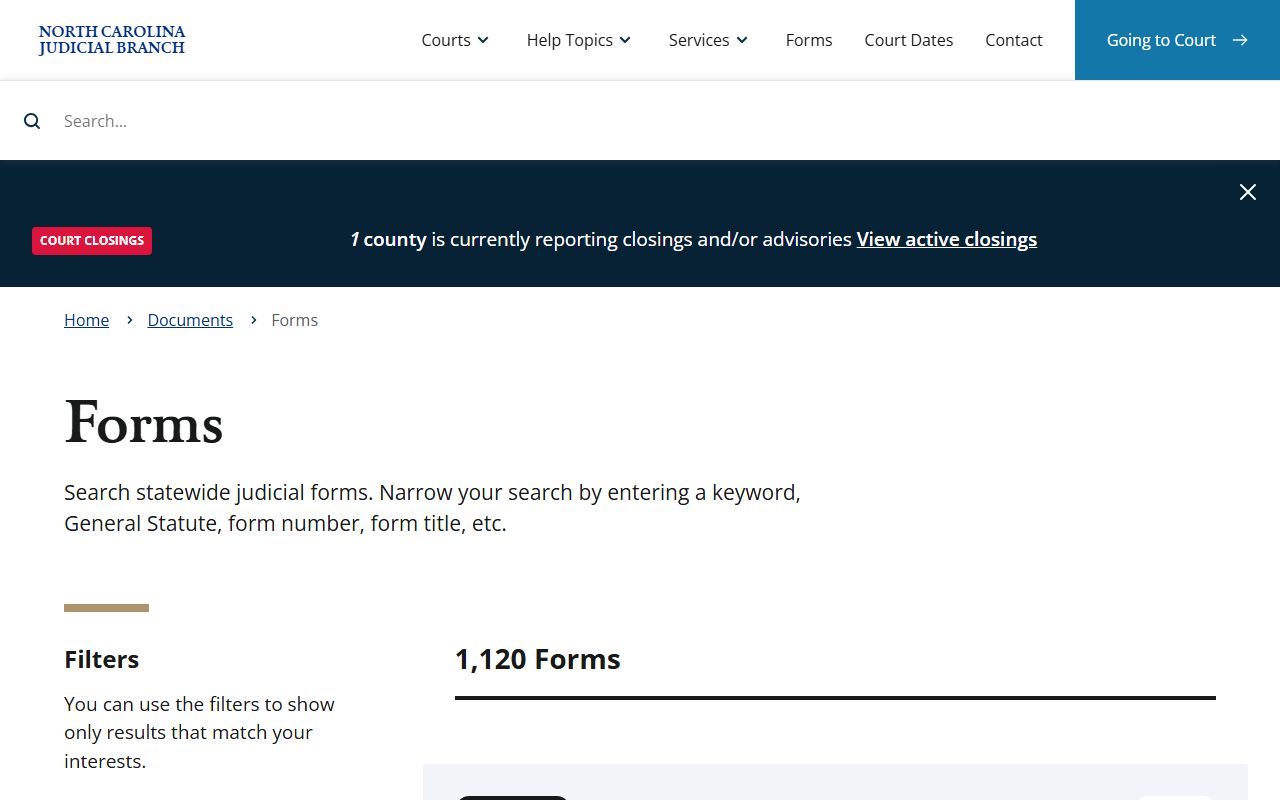
Forms for civil, criminal, family, estates, expunctions, and other case types are organized by category and available at no charge. Bring printed, completed forms to the Clerk's office or file through the eCourts system where available.
Cumberland County Clerk Fees and Payment Rules
Copy and certification fees in Cumberland County follow the North Carolina state court cost charts. The NC Judicial Branch publishes current cost charts on its court costs page. These charts set fees for plain copies, certified copies, certification charges, and filing fees. Because the charts update periodically, always confirm the current amount directly with the Clerk's office before you send payment by mail.
The Clerk's office enforces strict payment rules. Mail payments have narrower options than in-person payments. Online payments are available only for eligible matters. Processing fees apply to card transactions.
| Payment Method | In Person | By Mail | Online |
|---|---|---|---|
| Cash | Yes | No | No |
| Credit / Debit Card | Yes (processing fee) | No | Yes, eligible matters (processing fee) |
| Money Order | Yes | Yes | No |
| Certified Check | Yes | Yes | No |
| Personal Check | No | No | No |
Mail payments must be payable to Cumberland County Clerk of Superior Court and mailed to PO Box 363, Fayetteville, NC 28302. Always include the case number or citation number so staff can apply the payment to the correct file. The official Cumberland County payment information page covers in-person, mail, and online payment options in detail.
For estate and special proceeding fees, the controlling statute is N.C. Gen. Stat. § 7A-308. Pull the current court cost chart from the NC Judicial Branch before submitting an estate filing, as probate-related fees depend on the type of proceeding and the asset value involved.
| Item | Amount |
|---|---|
| Plain copy per page | See current state court cost chart |
| Certified copy (court record) | See current state court cost chart |
| Certification fee | See current state court cost chart |
| Estate / probate filing fees | Set by N.C.G.S. § 7A-308 and current cost chart |
| Card processing fee | Applied at time of transaction |
| Eligible traffic citation (online) | Card plus processing fee; see Portal payment options |
Note: Viewing and printing documents through the eCourts Portal for public cases has no fee, but those prints are not certified copies and cannot be used in formal legal proceedings.
eCourts Portal Is Not the Official Record
North Carolina uses the NC eCourts Portal for online case searches, hearing lookups, judgment index searches, and eligible payments. Cumberland County's NC Judicial Branch page links the Portal as "Portal (Search/Pay)." The Portal is useful for checking whether a case exists, reviewing public case summaries, finding a court date, and paying eligible fines online. It is free to use and does not require registration for basic searches.
But the official NC Judicial Branch Portal FAQ makes the distinction clear: the Portal is not the official court record. If you need a document to use in court, a loan, an immigration filing, or any legal process, the Portal printout will not work. You must contact the Clerk of Superior Court for an official certified copy. This is not a technicality. Courts, lenders, and government agencies require certified copies for a reason. The seal and clerk signature confirm the document has not been altered and matches the original file.
Portal vs. Certified Copy: The eCourts Portal shows public case information and updates within minutes of upload to the Odyssey system. It is good for research and checking court dates. It is not a substitute for a certified copy from the Clerk when an official record is required.
Filing is also handled separately. The Portal is for viewing and paying, not for filing new cases or submitting documents. Electronic filings go through eCourts File & Serve, the official e-filing system for North Carolina courts.
The screenshot below comes from the official eCourts File & Serve portal, the system used for electronic court filings in North Carolina.
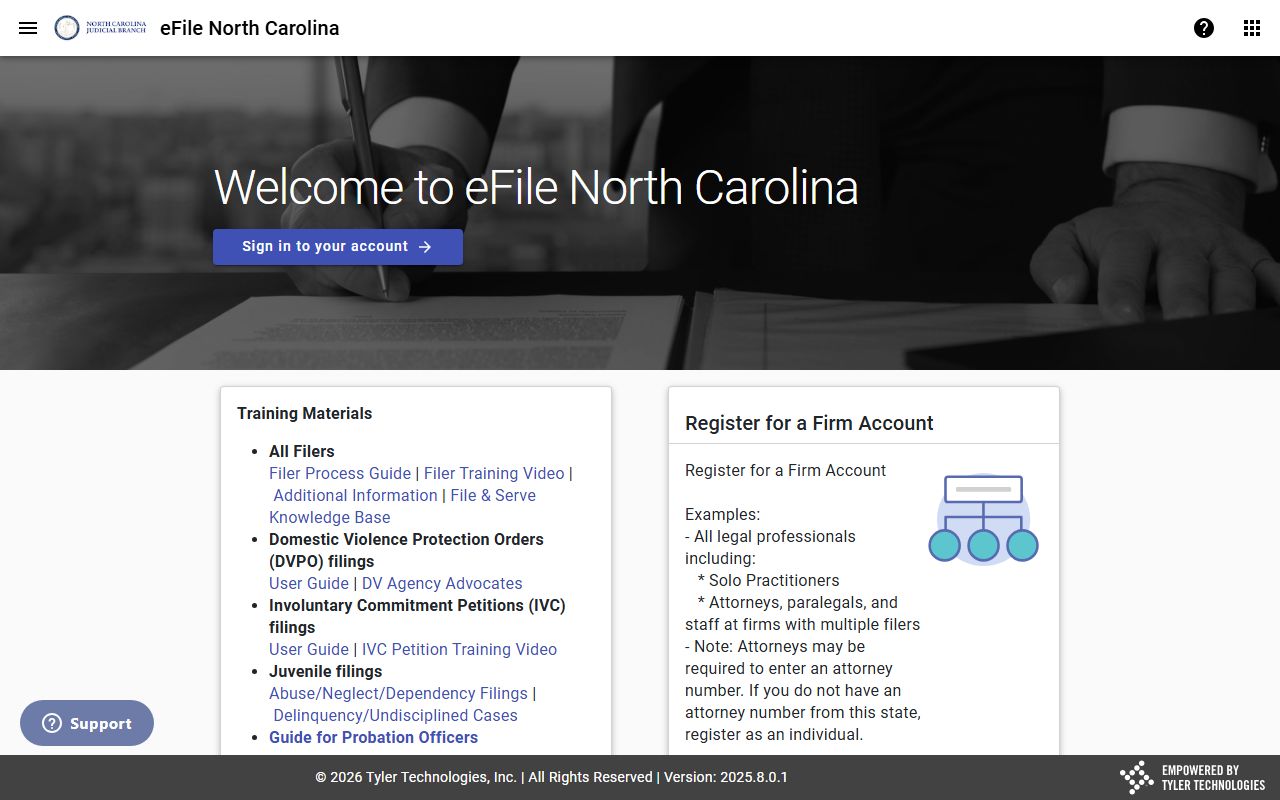
Attorneys and self-represented litigants who file electronically use this system; the Clerk of Superior Court processes those filings on the court side and maintains the official record in Odyssey.
Probate and Estates Through the Clerk
In North Carolina, the Clerk of Superior Court acts as the judge of probate. This means that when a person dies and their estate needs court supervision, the Clerk handles it, not a separate probate court. The NC Judicial Branch estates help page says estate administration is handled through the courts, primarily in the office of the appropriate Clerk of Superior Court, unless the decedent set up alternatives to court-supervised administration.
For Cumberland County estates, contact the Clerk of Superior Court at (910) 475-3000, at 117 Dick St., Fayetteville, NC 28301. A person starting a probate case typically brings the original will if one exists, a certified death certificate, applicant identification, heir and beneficiary information, an estimate of the assets, and the required AOC estate forms. The Clerk reviews the file, determines what type of administration applies, and issues letters if a personal representative is appointed.
The eCourts Portal includes an Estates advanced filtering option in Smart Search. Judgment Search also covers special proceedings. But as with all court matters, official estate records and certified letters come from the Clerk, not the Portal. For probate fees, the controlling source is N.C. Gen. Stat. § 7A-308 and the current state court cost charts.
- Testator
- A person who makes a will.
- Executor
- The person named in a will to carry out the estate.
- Administrator
- A personal representative appointed when there is no will or when the named executor cannot serve.
- Intestate
- Dying without a valid will; state law sets the distribution.
- Letters Testamentary
- The document the Clerk issues to authorize an executor to act on behalf of the estate.
- Guardianship
- A court-supervised arrangement where one person manages another's affairs; also handled by the Clerk as a special proceeding.
For more detail on the probate process and the record types involved, see the Cumberland County probate records page.
Cumberland County Local Rules and Forms
North Carolina courts use statewide AOC forms for most filings, but individual judicial districts may adopt local rules and supplemental forms. Cumberland County has its own set of local family and juvenile court forms approved for District 14. These forms are required for many filings in the family court and juvenile court divisions. Using the wrong or outdated form can delay a filing or result in rejection.
The official source for Cumberland local rules and forms is the Cumberland County local rules and forms page on the NC Judicial Branch site. Forms listed there include the CCFC-001 Family Court Notice, the CCLF-FC-004 Equitable Distribution Inventory Affidavit, the CCLF-FC-005 Equitable Distribution Affidavit, the CCLF-FC-006 Post-Separation Support Affidavit, the CCLF-FC-007 Domestic Case Motion for Continuance, and the CCLF-FC-010 Motion to Exempt Child Custody and Visitation Mediation. Juvenile session and continuance forms are also listed there.
- Cumberland County local rules and forms - required for family and juvenile filings in District 14.
- NC Judicial Branch AOC forms library - statewide forms for civil, criminal, family, estates, traffic, and expunctions.
- NC estates help topic - explains the probate process and links AOC estate forms.
Self-represented litigants can also use NC Guide & File, linked from the Cumberland County judicial page, which walks users through preparing documents for certain case types without an attorney. Filing still goes through the Clerk or the eCourts File & Serve system.
How the Register of Deeds Differs from the Clerk
Many people confuse the Clerk of Superior Court with the Register of Deeds. They are separate offices with different functions. The Clerk of Superior Court handles court records, estate administration, certified copies of court files, and court fees. The Register of Deeds handles land records, marriage licenses, birth and death certificates, notary oaths, assumed name filings, and military discharge recording. Neither office handles what the other covers.
The Register of Deeds for Cumberland County is an elected position currently held by Andra S. Brewington. The Register's office is inside the same courthouse complex, in Room 114, at 117 Dick Street, Fayetteville, NC 28301. The general phone is 910-678-7775. Vital records are reached at 910-678-7795 and land records at 910-678-7773. The official Register site is ccrod.org, and the land-record and vital-record search portal is at ccrodinternet.org.
The screenshot below comes from the official Cumberland County Register of Deeds fee schedule page.
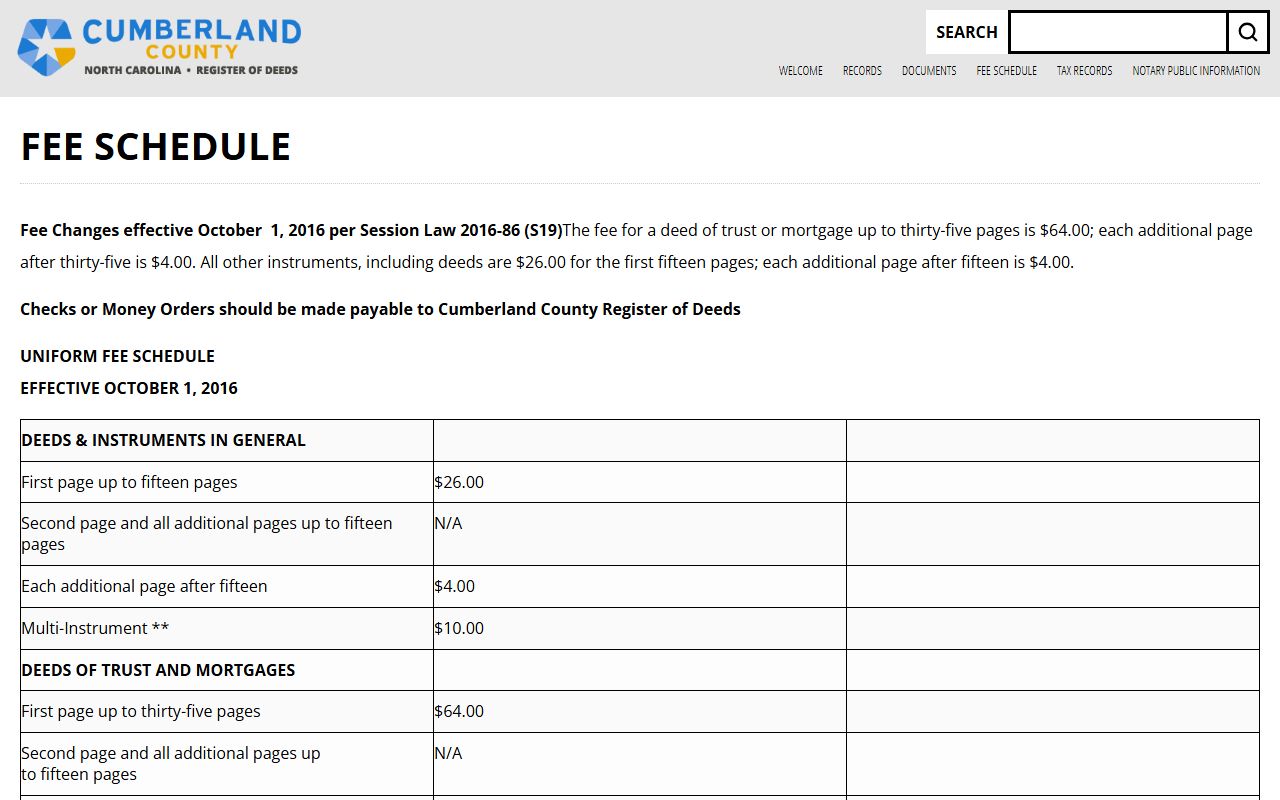
This page lists land-record recording fees, certified copy costs, and other Register charges, which are separate from the Clerk of Superior Court fee schedule used for court records and certified case documents.
| Need | Go To | Contact |
|---|---|---|
| Certified copy of a court order or judgment | Clerk of Superior Court | (910) 475-3000 |
| Certified copy of a divorce decree (case file) | Clerk of Superior Court | (910) 475-3000 |
| Estate letters or probate records | Clerk of Superior Court | (910) 475-3000 |
| Marriage license application | Register of Deeds | 910-678-7775 |
| Certified copy of marriage certificate | Register of Deeds | 910-678-7775 or 910-678-7795 |
| Birth or death certificate | Register of Deeds | 910-678-7795 |
| Land deed or mortgage records | Register of Deeds | 910-678-7773 |
| DD-214 military discharge recording | Register of Deeds | 910-678-7775 (no fee) |
Both offices are in the same building, which makes one courthouse visit useful for mixed record needs. For marriage and divorce records in detail, see Cumberland County marriage and divorce records.